Lecture Code : SS02-S4
Session Name : Satellite Symposium 1 (Sponsored by Otsuka)
Session Topic : Satellite Symposium 1 (Sponsored by Otsuka)
Date & Time, Place : June 12 (Fri) / 10:20-12:00 / Room 4 (203), 2F
Effectiveness of abdominal bracing core exercises as rehabilitation therapy for reducing abdominal symptoms in patients with autosomal dominant polycystic kidney disease and significant polycystic liver disease
Hyunsuk Kim
Chuncheon Sacred Heart Hospital, Republic of Korea
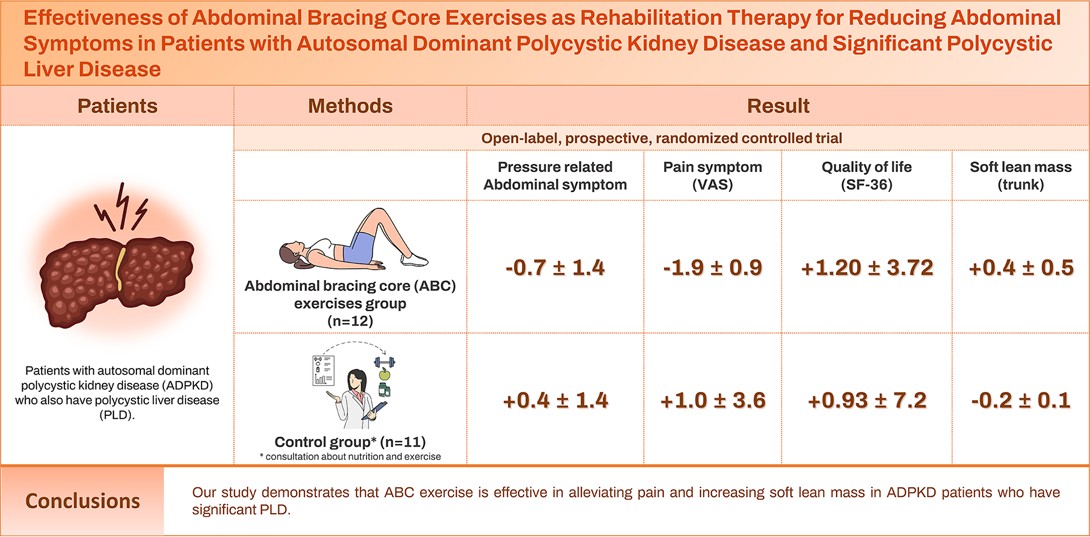
In patients with autosomal dominant polycystic kidney disease (ADPKD) who also have polycystic liver disease (PLD), organomegaly often leads to abdominal symptoms. Abdominal bracing core (ABC) exercises have been validated as effective for alleviating chronic back pain. The purpose of this study was to assess the effectiveness of ABC rehabilitation exercises in reducing pain in ADPKD patients with significant PLD. Significant PLD was defined as a height-adjusted total liver volume (htTLV) exceeding 1,600 mL/m². The intervention group (n=12) participated in ABC exercises, while the control group (n=11) received only a consultation about nutrition and exercise, along with a recommendation for regular exercise. After a 3-month biweekly intervention, changes in pain, abdominal symptoms, quality of life (QoL), and bioelectrical impedance analysis (BIA) were analyzed. The participants comprised 23 individuals (male: 4 [17.4%], female: 19 [82.6%]). Their mean age was 54, and the mean ± SD of htTLV was 2,706 ± 1,335. The mean ± SD of eGFR was 53.9±29.0 mL/min/1.73m2. After the intervention, pain and pressure-related symptoms significantly decreased in some cases; however, gastrointestinal symptoms did not improve. Pain and QoL -assessed by the Korean Oswestry Disability Index (KODI) and the second version of the short-form 36-item Health Survey- showed significant improvements. The results of BIA indicated a noticeable change in the soft lean mass of the proximal body following the intervention. Our study demonstrates that ABC exercise is effective in alleviating pain and increasing soft lean mass in ADPKD patients who have significant PLD.
Keywords: Autosomal dominant polycystic kidney disease, Polycystic liver disease, Exercise therapy, bioimpedance
abstract.jpg