Lecture Code : JS04-S4
Session Name : KSN-ESPN Joint Symposium
Session Topic : KSN-ESPN Joint Symposium
Date & Time, Place : June 12 (Fri) / 13:50-15:30 / Room 1 (GBR 101), 1F
Longitudinal Progression Trajectory of eGFR in Korean Children with CKD
Eun Mi Yang
Chonnam National University Hospital, Republic of Korea
The natural progression of chronic kidney disease (CKD) in the pediatric population is highly heterogeneous. Predicting which patients will experience rapid renal decline remains a significant challenge, particularly when baseline clinical parameters appear similar. Although the overall estimated glomerular filtration rate (eGFR) typically follows a linear decline over time, individual variations are substantial and heavily influenced by underlying etiology and early clinical markers.
We identified distinct patterns of eGFR trajectories in Korean children using data from the KoreaN cohort study for Outcomes in patients With Pediatric Chronic Kidney Disease (KNOW-Ped CKD), a longitudinal, prospective multicenter study. A total of 287 patients with long-term follow-up data were analyzed to investigate the specific clinical factors, including proteinuria and underlying disease, associated with different progression patterns.
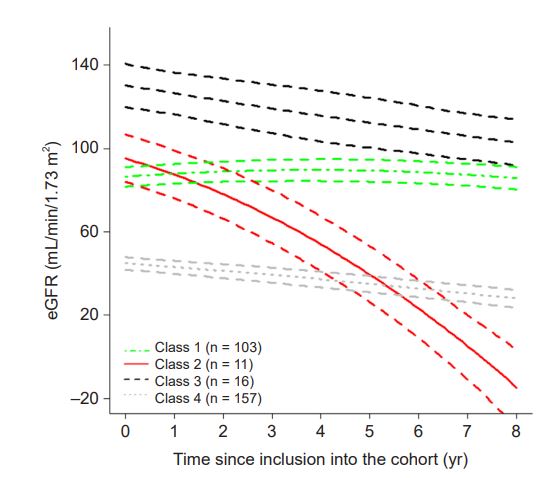
Using latent class modeling, we identified four distinct eGFR trajectory classes, each characterized by a unique rate of decline and baseline kidney function:
Class 1 (Stable, n=103): This group maintained a relatively stable eGFR throughout the follow-up period.
Class 2 (Consistent Fast Decline, n=11): This class exhibited a rapid and steep decrease in eGFR. Despite having relatively preserved eGFR at enrollment, these patients showed the most aggressive progression.
Class 3 (Consistent Gradual Decline, n=16): Patients in this group started with a high baseline eGFR (Stage 1) but showed a steady, gradual decline. This group was younger at enrollment and had a higher prevalence of glomerulopathy.
Class 4 (Consistent Slow Decline, n=157): The largest group, characterized by a slow and persistent decline in kidney function from a lower baseline.
Several clinical markers varied significantly across these classes. Notably, higher levels of proteinuria were strongly associated with rapid progression, and glomerulopathy was more prevalent in the groups showing significant eGFR decline (Classes 2 and 3).
The identification of these four trajectories suggests that baseline eGFR alone is insufficient to predict the long-term course of pediatric CKD. This study provides a strong clinical rationale for more intensive monitoring of children identified in fast-declining trajectories. Furthermore, future policy support should facilitate early, personalized management strategies for high-risk groups to improve long-term renal outcomes in the pediatric population.
Keywords: Chronic kidney disease, Disease progression, Trajectory, Child, Latent class linear mixed model
figure.JPG