Abstract Type : Oral presentation
Abstract Submission No.: A-1046
Abstract Topic : Glomerular and Tubulointerstitial Disorders
Histopathologic Correlates of Kidney Function and Diagnosis in Glomerular Disease Identified Through Unsupervised Learning
Min Woo Kang
Department of Internal Medicine-Nephrology, Korea University Guro Hospital, Korea, Republic of
Objectives : Histopathologic evaluation of kidney biopsy remains the gold standard for diagnosis and risk stratification in glomerular diseases, yet routine assessment relies on semi-quantitative scoring and expert interpretation, which may under-represent continuous and composite morphologic variation. Unsupervised representation learning using pathology foundation models offers a hypothesis-free framework to characterize renal histology beyond predefined lesion categories.
Methods : We analyzed Periodic acid–Schiff–stained whole-slide images from the KOrea Renal biobank NEtwoRk System TOward NExt-generation analysis (KORNERSTONE), a prospective multi-institutional cohort. Multiple patch extraction strategies—global whole-tissue, glomerulus-guided (200×, 400×, and instance-level), and instance-based sampling—were applied. Patches were embedded using three pretrained pathology foundation models (UNI, CONCH, and a pan-cancer model), followed by dimensionality reduction and unsupervised K-means clustering. Subject-level cluster-compositional profiles were constructed and evaluated for association with biopsy-confirmed diagnoses and renal function outcomes, including short-term (≥40% eGFR decline within 3 months) and longer-term deterioration. Model performance was assessed using internal cross-validation, external validation across institutions, and a temporally independent validation cohort.
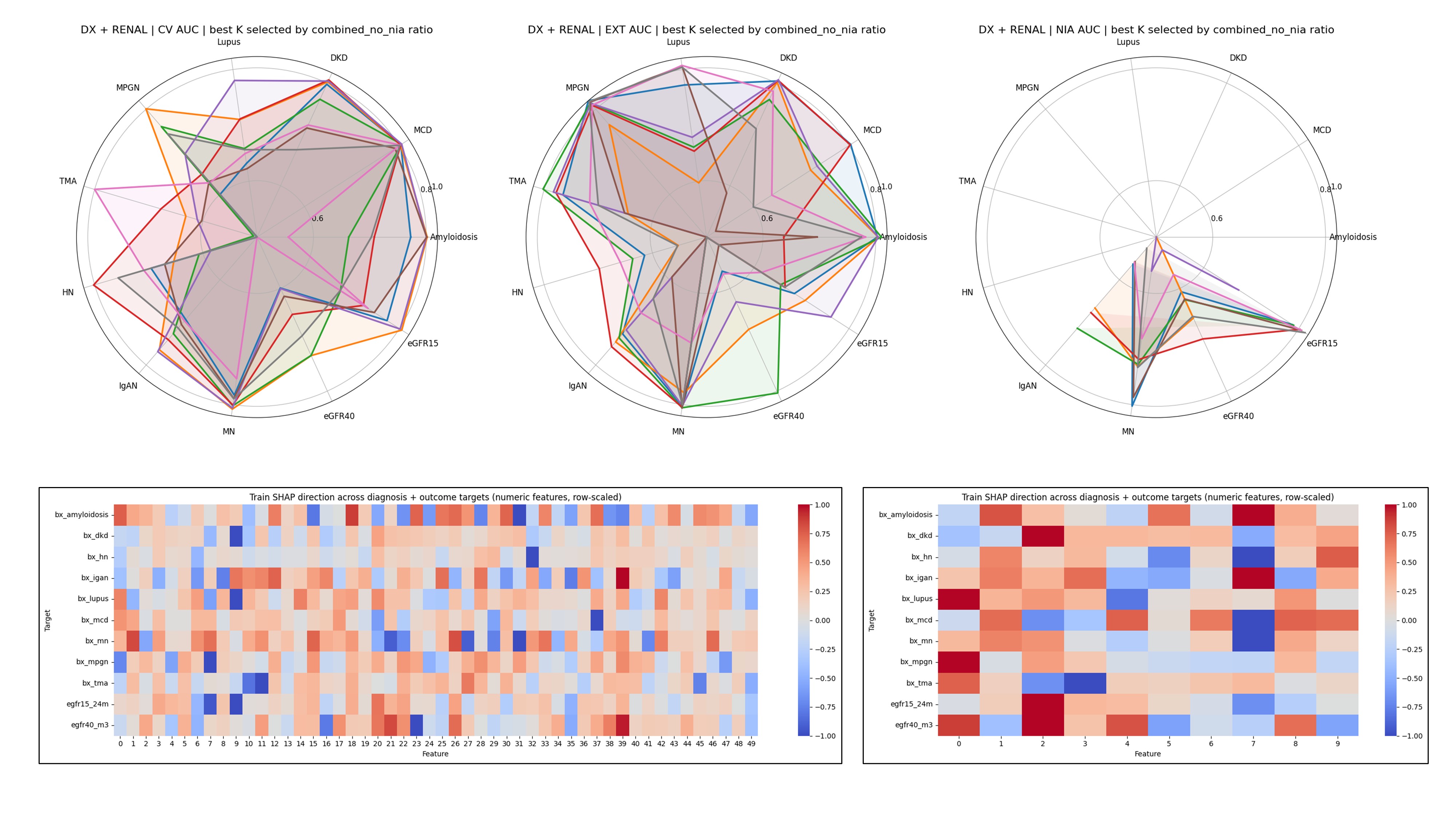
Results : Cluster-compositional representations demonstrated consistent associations with both diagnosis and renal function. Glomerulus-centered representations showed the most stable and robust performance for diagnostic classification across validation settings. For short-term renal deterioration, high-resolution glomerular patches (400×) achieved the strongest generalization in the temporally independent cohort (AUC 0.9115). In contrast, global whole-tissue representations demonstrated superior inter-site robustness for longer-term functional decline. Cluster-compositional features alone retained meaningful discriminative capacity, and performance improved incrementally with the addition of demographic and clinical covariates.
Conclusions : Foundation model–derived unsupervised morphologic phenotyping enables reproducible, data-driven characterization of kidney biopsy histology and reveals task-aligned relationships between anatomical focus and clinical endpoint. This framework provides a scalable approach for morphology–function–diagnosis modeling in glomerular disease and complements conventional expert-driven interpretation.
Methods : We analyzed Periodic acid–Schiff–stained whole-slide images from the KOrea Renal biobank NEtwoRk System TOward NExt-generation analysis (KORNERSTONE), a prospective multi-institutional cohort. Multiple patch extraction strategies—global whole-tissue, glomerulus-guided (200×, 400×, and instance-level), and instance-based sampling—were applied. Patches were embedded using three pretrained pathology foundation models (UNI, CONCH, and a pan-cancer model), followed by dimensionality reduction and unsupervised K-means clustering. Subject-level cluster-compositional profiles were constructed and evaluated for association with biopsy-confirmed diagnoses and renal function outcomes, including short-term (≥40% eGFR decline within 3 months) and longer-term deterioration. Model performance was assessed using internal cross-validation, external validation across institutions, and a temporally independent validation cohort.
Results : Cluster-compositional representations demonstrated consistent associations with both diagnosis and renal function. Glomerulus-centered representations showed the most stable and robust performance for diagnostic classification across validation settings. For short-term renal deterioration, high-resolution glomerular patches (400×) achieved the strongest generalization in the temporally independent cohort (AUC 0.9115). In contrast, global whole-tissue representations demonstrated superior inter-site robustness for longer-term functional decline. Cluster-compositional features alone retained meaningful discriminative capacity, and performance improved incrementally with the addition of demographic and clinical covariates.
Conclusions : Foundation model–derived unsupervised morphologic phenotyping enables reproducible, data-driven characterization of kidney biopsy histology and reveals task-aligned relationships between anatomical focus and clinical endpoint. This framework provides a scalable approach for morphology–function–diagnosis modeling in glomerular disease and complements conventional expert-driven interpretation.
Figure 1.jpg
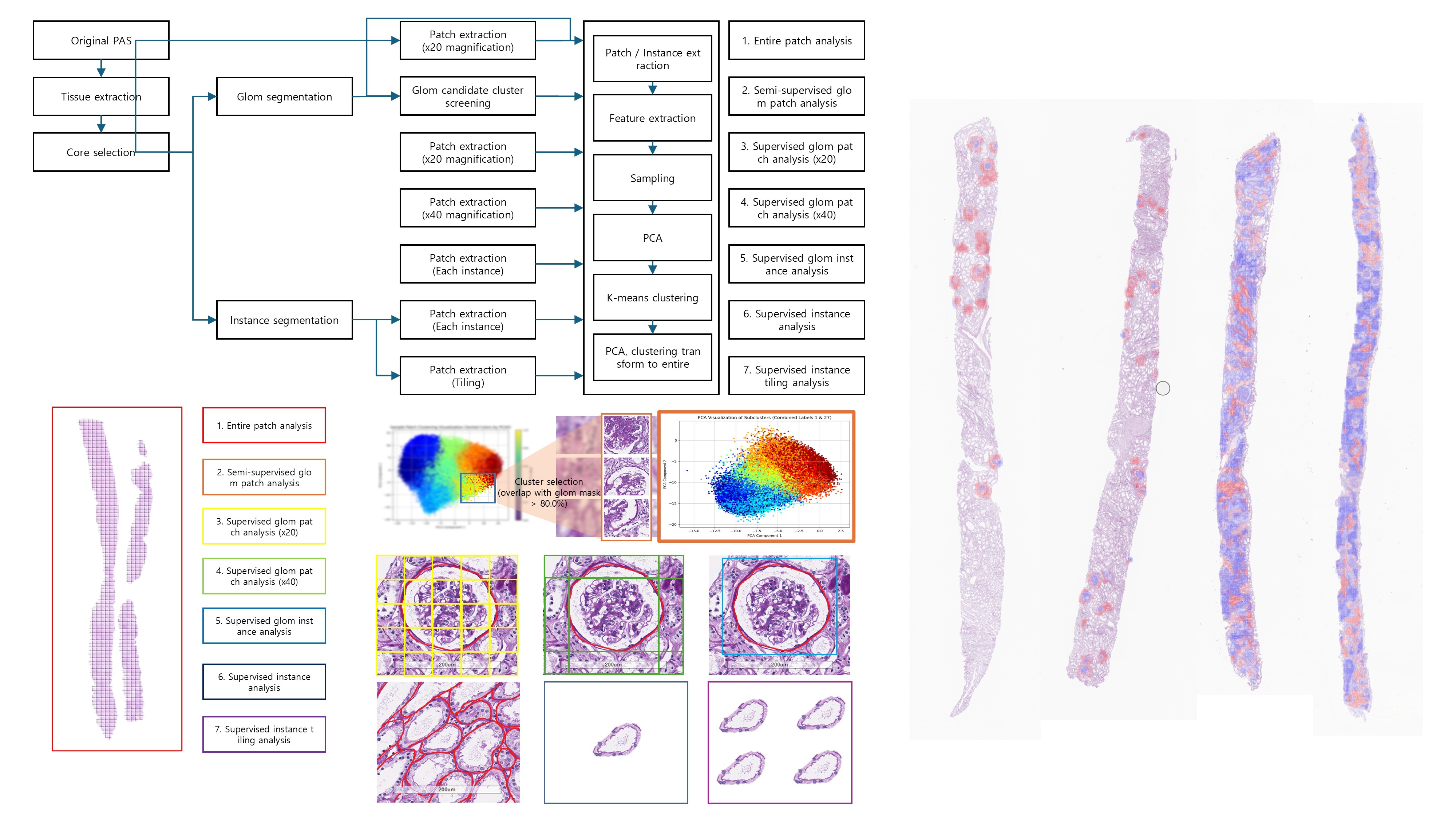
Figure 1.jpg