Abstract Type : Oral presentation
Abstract Submission No.: A-0990
Abstract Topic : Hypertensive Kidney Disease + Vascular Biology in CKD
The Ang2/Ang1 Ratio as an Independent Predictor of MACE in Hypertensive CKD Patients
Jeeyoung Kim1, Minsang Kim2, Eunjeong Kang2, Kook-Hwan Oh2, Yon Su Kim2, Seung Hee Yang3, Hajeong Lee2
1Department of Internal Medicine-Nephrology, Chung-Ang University Hospital, Korea, Republic of
2Department of Internal Medicine, Seoul National University Hospital, Korea, Republic of
3Department of Biomedical Research Institute, Seoul National University Hospital, Korea, Republic of
Objectives : Endothelial dysfunction underlies progressive glomerular injury in CKD. Within the Angiopoietin-Tie2 axis, Angiopoietin-2 (Ang2) competitively antagonizes Angiopoietin-1 (Ang1), destabilizing endothelial Tie2 signaling. An elevated Ang2/Ang1 ratio may therefore quantify the degree of endothelial imbalance. Whether this ratio and circulating sTie2 predict renal and cardiovascular outcomes in CKD has not been established in a large prospective cohort.
Methods : We analyzed patients with stage 1–3B CKD except polycystic kidney disease from the KNOW-CKD, a nationwide prospective longitudinal cohort. Serum Ang1, Ang2, and sTie2 were measured by ELISA. The primary kidney outcome was renal event defined as eGFR halving, serum creatinine doubling, or progression to kidney failure. Secondary outcomes included all-cause mortality and major adverse cardiovascular events (MACE). The hypertensive subgroup was operationally defined as patients taking two or more antihypertensive medications.
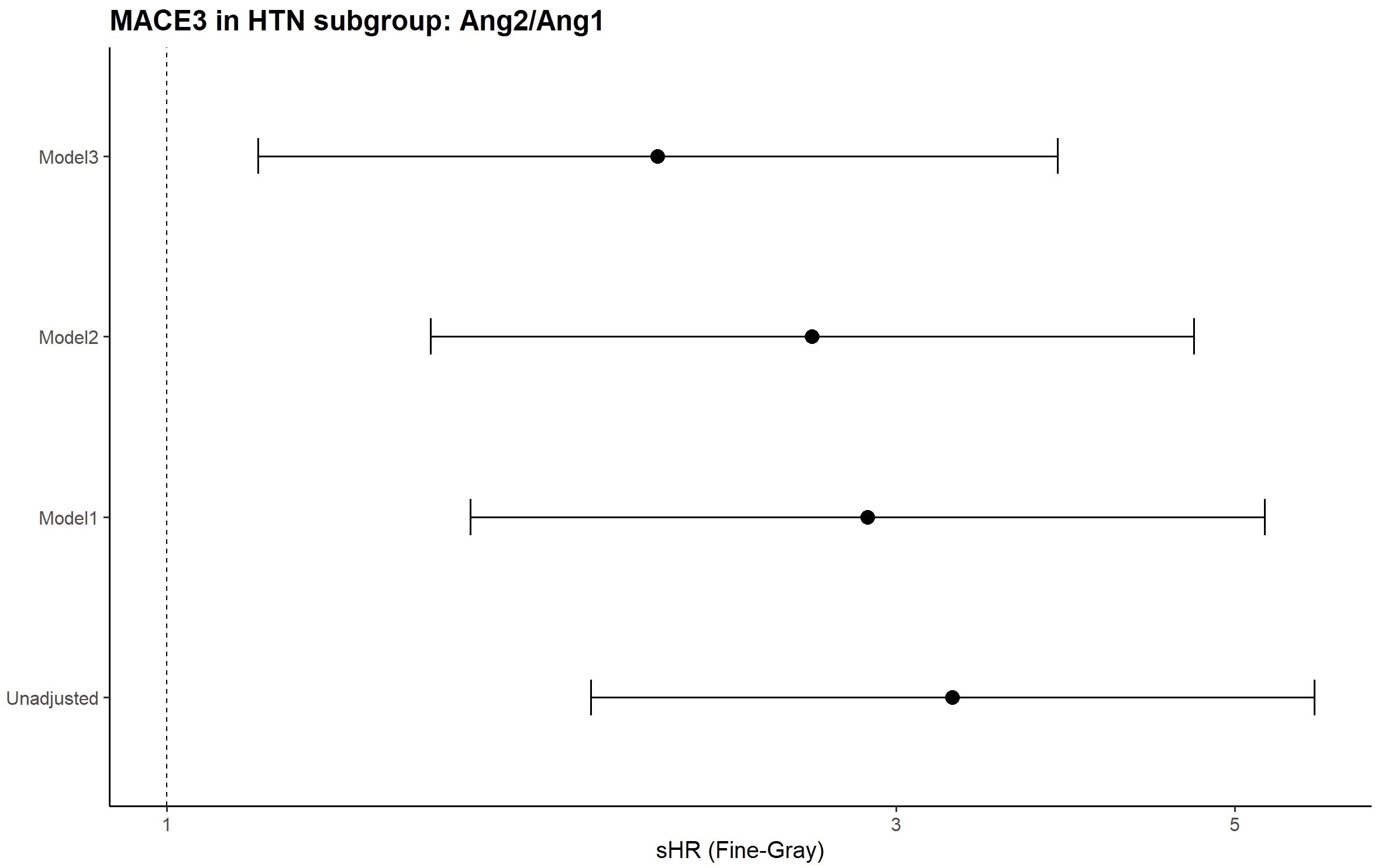
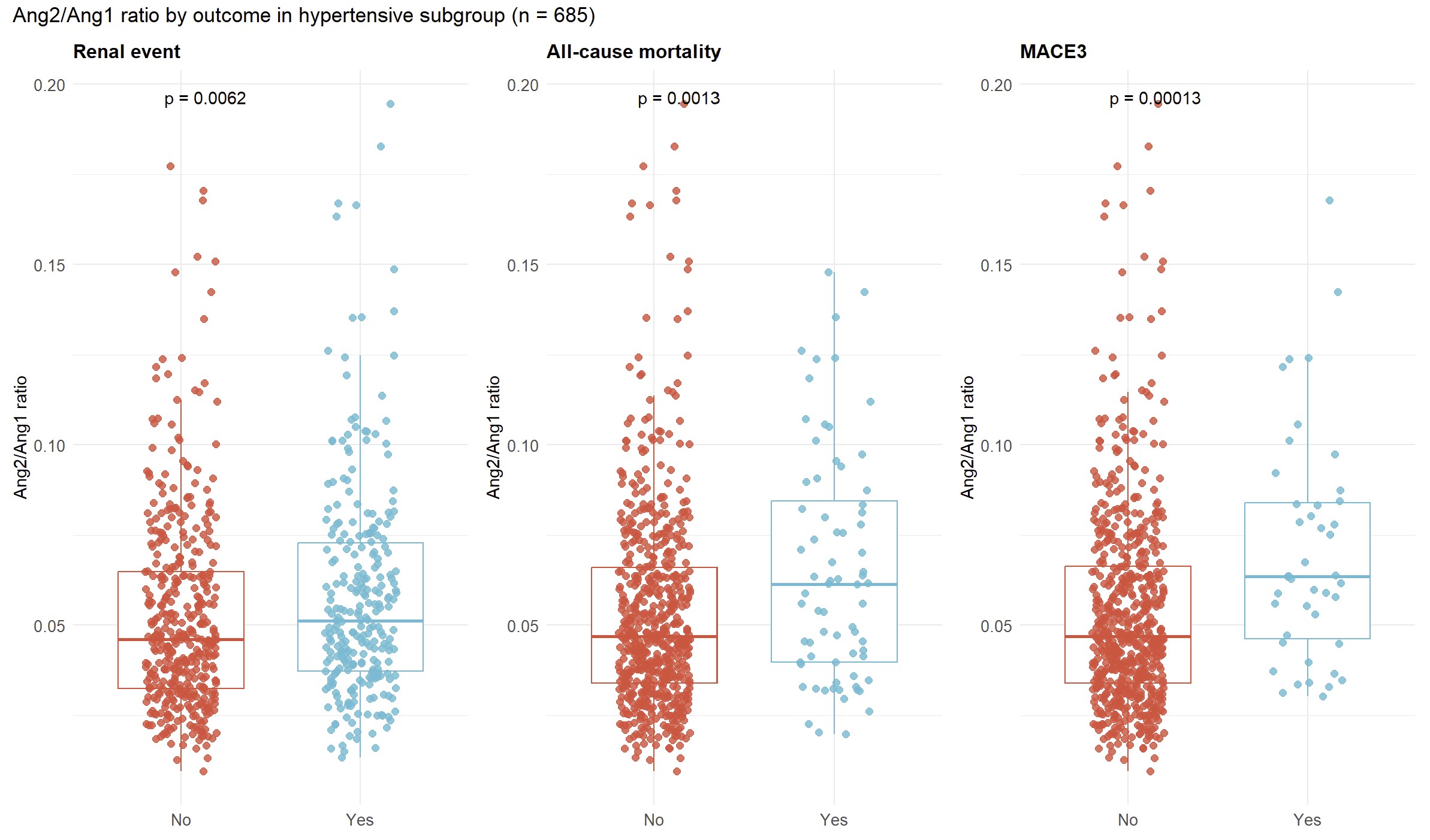
Results : Among 1,186 CKD patients, 137 were classified as stage 1, 312 as stage 2, 306 as stage 3a, and 431 as stage 3b. During a median follow-up of 9.5 years, 379 renal progression events, 104 all-cause deaths, and 67 MACE were observed. Overall, the Ang2/Ang1 ratio increased progressively with CKD stage. In addition, the Ang2/Ang1 ratio was higher in patients who experienced renal events and all-cause mortality, especially in hypertensive subgroup (n=685). Interestingly, this ratio was also higher in hypertensive patients who experienced MACE. In multivariable Fine-Gray competing risk regression, a higher Ang2/Ang1 ratio was independently associated with MACE in the hypertensive CKD patients even after adjusting for age, sex, baseline eGFR, UACR, hemoglobin, and albumin.
Conclusions : The Ang2/Ang1 ratio increases with CKD progression and is associated with adverse renal and cardiovascular outcomes in hypertensive CKD patients. Notably, its association with MACE remained significant after full multivariable adjustment, supporting the Ang2/Ang1 ratio as a clinically relevant biomarker for cardiovascular risk stratification in hypertensive CKD.
Methods : We analyzed patients with stage 1–3B CKD except polycystic kidney disease from the KNOW-CKD, a nationwide prospective longitudinal cohort. Serum Ang1, Ang2, and sTie2 were measured by ELISA. The primary kidney outcome was renal event defined as eGFR halving, serum creatinine doubling, or progression to kidney failure. Secondary outcomes included all-cause mortality and major adverse cardiovascular events (MACE). The hypertensive subgroup was operationally defined as patients taking two or more antihypertensive medications.
Results : Among 1,186 CKD patients, 137 were classified as stage 1, 312 as stage 2, 306 as stage 3a, and 431 as stage 3b. During a median follow-up of 9.5 years, 379 renal progression events, 104 all-cause deaths, and 67 MACE were observed. Overall, the Ang2/Ang1 ratio increased progressively with CKD stage. In addition, the Ang2/Ang1 ratio was higher in patients who experienced renal events and all-cause mortality, especially in hypertensive subgroup (n=685). Interestingly, this ratio was also higher in hypertensive patients who experienced MACE. In multivariable Fine-Gray competing risk regression, a higher Ang2/Ang1 ratio was independently associated with MACE in the hypertensive CKD patients even after adjusting for age, sex, baseline eGFR, UACR, hemoglobin, and albumin.
Conclusions : The Ang2/Ang1 ratio increases with CKD progression and is associated with adverse renal and cardiovascular outcomes in hypertensive CKD patients. Notably, its association with MACE remained significant after full multivariable adjustment, supporting the Ang2/Ang1 ratio as a clinically relevant biomarker for cardiovascular risk stratification in hypertensive CKD.
Tie2_figure1.jpg
Tie2_figure1.jpg