Abstract Type : Oral presentation
Abstract Submission No.: A-0937
Abstract Topic : Hypertensive Kidney Disease + Vascular Biology in CKD
Cuffless Ring Photoplethysmography for 24-Hour Blood Pressure Monitoring in Hemodialysis Patients: Validation Against Ambulatory BP Monitoring and Assessment of Dipping Pattern Agreement
Jong Hyun Jhee1, Chunghwan Lee1, Wooram Bae1, Hoon Young Choi1, Hyeong Cheon Park1, Seng Chan You2, Kyeong-Hyeon Chun3
1Department of Internal Medicine-Nephrology, Gangnam Severance Hospital, Korea, Republic of
2Department of Department of Biomedical Systems Informatics, Severance Hospital, Korea, Republic of
3Department of Internal Medicine-Cardiology, Gangnam Severance Hospital, Korea, Republic of
Objectives : Hemodialysis patients have a high cardiovascular risk, and nocturnal B) dipping is an important prognostic marker. Although ABPM is the reference standard for 24-hour BP assessment, cuffless photoplethysmography-based devices may provide a more convenient alternative. However, their performance in hemodialysis patients remains insufficiently validated.
Methods : We prospectively enrolled 36 hemodialysis patients at Gangnam Severance Hospital. ABPM (TM-2441, A&D Medical; n = 33) and a cuffless ring-based BP device (CART; n = 34) were simultaneously recorded; 32 patients had paired measurements for analysis. Daytime and nighttime periods were defined using device-specific sleep annotations. Agreement was evaluated using Pearson correlation and Bland–Altman analysis with limits of agreement (LOA). Nocturnal dipping patterns were classified to assess concordance using Cohen’s kappa.
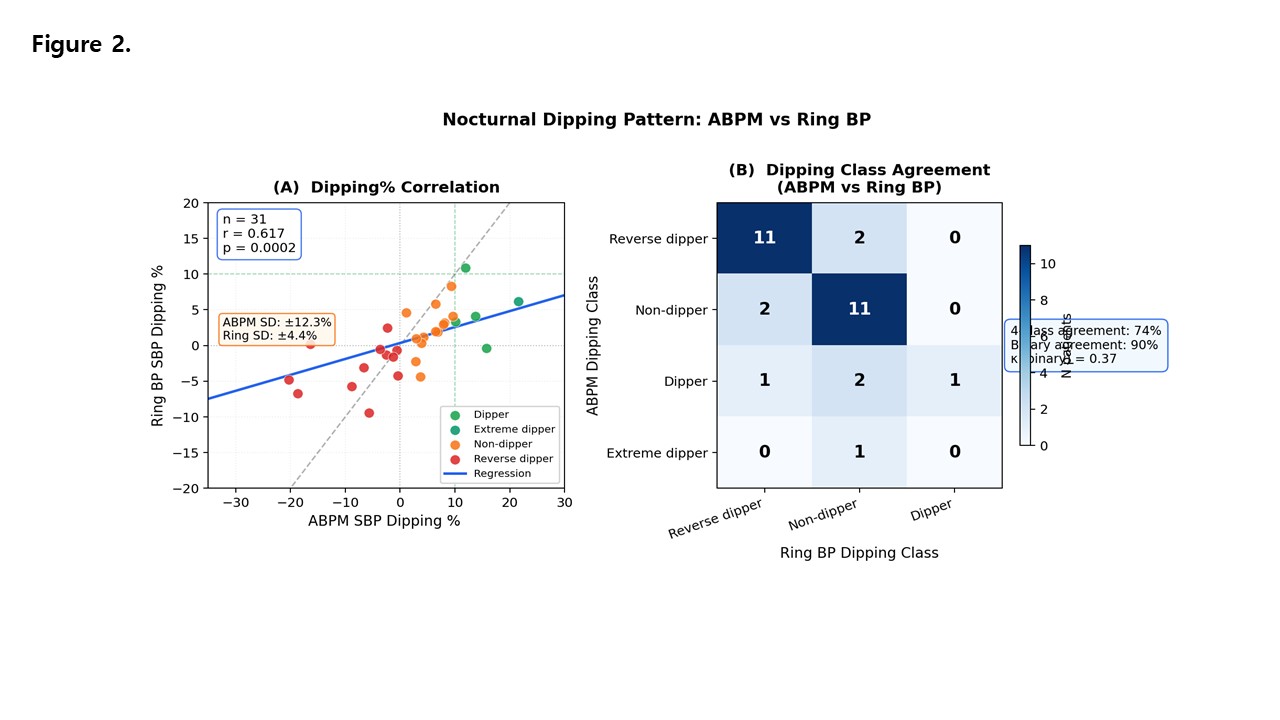
Results : Ring BP showed strong correlations with ABPM for 24-hour systolic BP (SBP) and diastolic BP (DBP) (SBP r = 0.829; DBP r = 0.855; both p < 0.0001). However, the ring device systematically underestimated BP values, with a mean SBP difference of −14.2 ± 14.5 mmHg (LOA −42.6 to +14.2 mmHg) and DBP difference of −7.8 ± 6.3 mmHg. The degree of underestimation was greater in sustained hypertension (−22.1 ± 12.5 mmHg) than in normotension (+1.6 ± 9.6 mmHg), suggesting proportional bias at higher BP levels. ABPM classified patients as reverse dippers (45%), non-dippers (42%), and dippers (13%). Binary agreement for dipper versus non-dipper status was 90.3% (κ = 0.37), largely driven by concordance in non-dippers (27/27). owever, the ring device detected only 1 of 4 true dippers (sensitivity 25%, specificity 100%), reflecting a compressed distribution of dipping percentage (SD 4.6% vs. 12.3% with ABPM).
Conclusions : In hemodialysis patients, cuffless ring-based BP monitoring correlated with ABPM but underestimated BP, particularly at higher levels. Non-dipping patterns were largely concordant, but detection of true dippers was limited, requiring calibration refinement before replacing ABPM.
Methods : We prospectively enrolled 36 hemodialysis patients at Gangnam Severance Hospital. ABPM (TM-2441, A&D Medical; n = 33) and a cuffless ring-based BP device (CART; n = 34) were simultaneously recorded; 32 patients had paired measurements for analysis. Daytime and nighttime periods were defined using device-specific sleep annotations. Agreement was evaluated using Pearson correlation and Bland–Altman analysis with limits of agreement (LOA). Nocturnal dipping patterns were classified to assess concordance using Cohen’s kappa.
Results : Ring BP showed strong correlations with ABPM for 24-hour systolic BP (SBP) and diastolic BP (DBP) (SBP r = 0.829; DBP r = 0.855; both p < 0.0001). However, the ring device systematically underestimated BP values, with a mean SBP difference of −14.2 ± 14.5 mmHg (LOA −42.6 to +14.2 mmHg) and DBP difference of −7.8 ± 6.3 mmHg. The degree of underestimation was greater in sustained hypertension (−22.1 ± 12.5 mmHg) than in normotension (+1.6 ± 9.6 mmHg), suggesting proportional bias at higher BP levels. ABPM classified patients as reverse dippers (45%), non-dippers (42%), and dippers (13%). Binary agreement for dipper versus non-dipper status was 90.3% (κ = 0.37), largely driven by concordance in non-dippers (27/27). owever, the ring device detected only 1 of 4 true dippers (sensitivity 25%, specificity 100%), reflecting a compressed distribution of dipping percentage (SD 4.6% vs. 12.3% with ABPM).
Conclusions : In hemodialysis patients, cuffless ring-based BP monitoring correlated with ABPM but underestimated BP, particularly at higher levels. Non-dipping patterns were largely concordant, but detection of true dippers was limited, requiring calibration refinement before replacing ABPM.
Figure 1.jpg
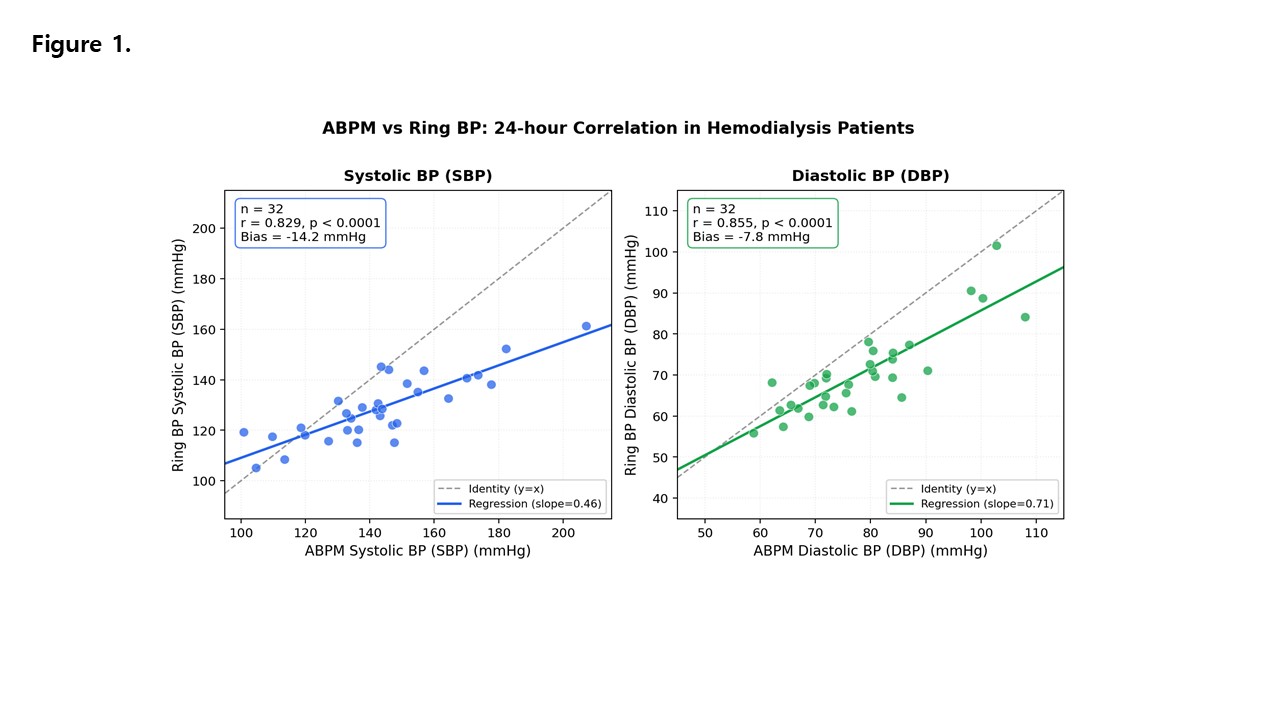
Figure 1.jpg