Abstract Type : Oral presentation
Abstract Submission No.: A-0844
Abstract Topic : Non-dialysis CKD
Characteristics of Dietary Sodium Intake Assessed by 24-Hour Urine Collection in Korean Patients with Chronic Kidney Disease: Insights from the K-SALT Study
Woo-yeong Park1, Semin Cho2, Ji-Young Choi3, Seo Rin Kim4, Hayne Cho Park5, Haekyung Lee6, Jangwook Lee7, Seun Deuk Hwang8, Sang Heon Suh9, Ji Yong Jung10
1Department of Internal Medicine-Nephrology, Keimyung University Dongsan Medical Center, Korea, Republic of
2Department of Internal Medicine-Nephrology, Chung-Ang University Gwangmyeong Hospital, Korea, Republic of
3Department of Internal Medicine-Nephrology, Kyungpook National University Medical Center, Korea, Republic of
4Department of Internal Medicine-Nephrology, Pusan National University Yangsan Hospital, Korea, Republic of
5Department of Internal Medicine-Nephrology, Kangnam Sacred Heart Hospital, Korea, Republic of
6Department of Internal Medicine-Nephrology, Soonchunhyang University Seoul Hospital, Korea, Republic of
7Department of Internal Medicine-Nephrology, Dongguk University Ilsan Hospital, Korea, Republic of
8Department of Internal Medicine-Nephrology, Inha University Hospital, Korea, Republic of
9Department of Internal Medicine-Nephrology, Chonnam National University Hospital, Korea, Republic of
10Department of Internal Medicine-Nephrology, Gachon University Gil Medical Center, Korea, Republic of
Methods : We conducted the K-SALT study, a multicenter cohort of 1,640 adults with CKD from 16 Korean hospitals who completed a 24-hour urine collection between 2013 and 2025. Sodium intake was assessed using 24-hour urinary sodium excretion (24hrUNa). Associations with age, sex, body mass index (BMI), residential region, season, comorbidities, medication use, and estimated glomerular filtration rate (eGFR) were examined.
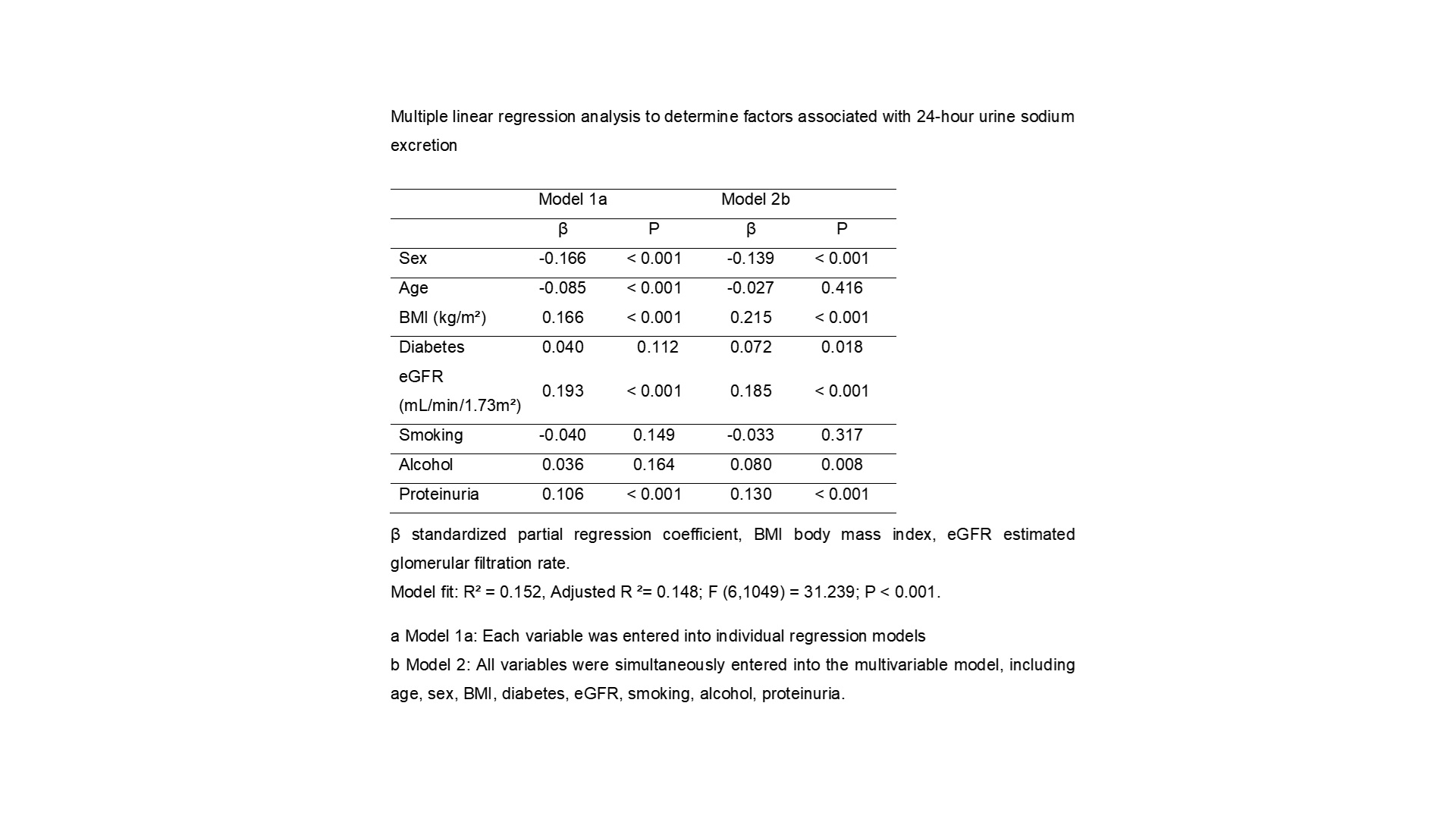
Results : Mean 24hrUNa was 149.7 ± 89.6 mmol/day and an estimated salt intake, 8.8 ± 5.2 g/day. Sodium excretion was correlated positively with eGFR (r=0.186, P < 0.001) and declined with advancing CKD stage. Male had higher sodium excretion than female, and 24hrUNa increased with increasing BMI (P < 0.001). In multivariable analysis, male, higher BMI, BMD, eGFR, and proteinuria were associated with higher 24hrUNa, whereas age, hypertension, and diabetes were not independently associated. Sodium excretion did not differ significantly by residential region or season. Use of loop diuretics, thiazides, and mineralocorticoid receptor antagonists was not independently associated with 24hrUNa, whereas sodium-glucose cotransporter 2 inhibitor use showed a modest association.
Conclusions : In the K-SALT study cohort, dietary sodium exposure measured by 24-hour urine collection remained above recommended targets and was more strongly associated with kidney function, sex, and BMI than with comorbidity status. Objective assessment using 24hrUNa may support individualized, stage-specific dietary counseling in patients with CKD.
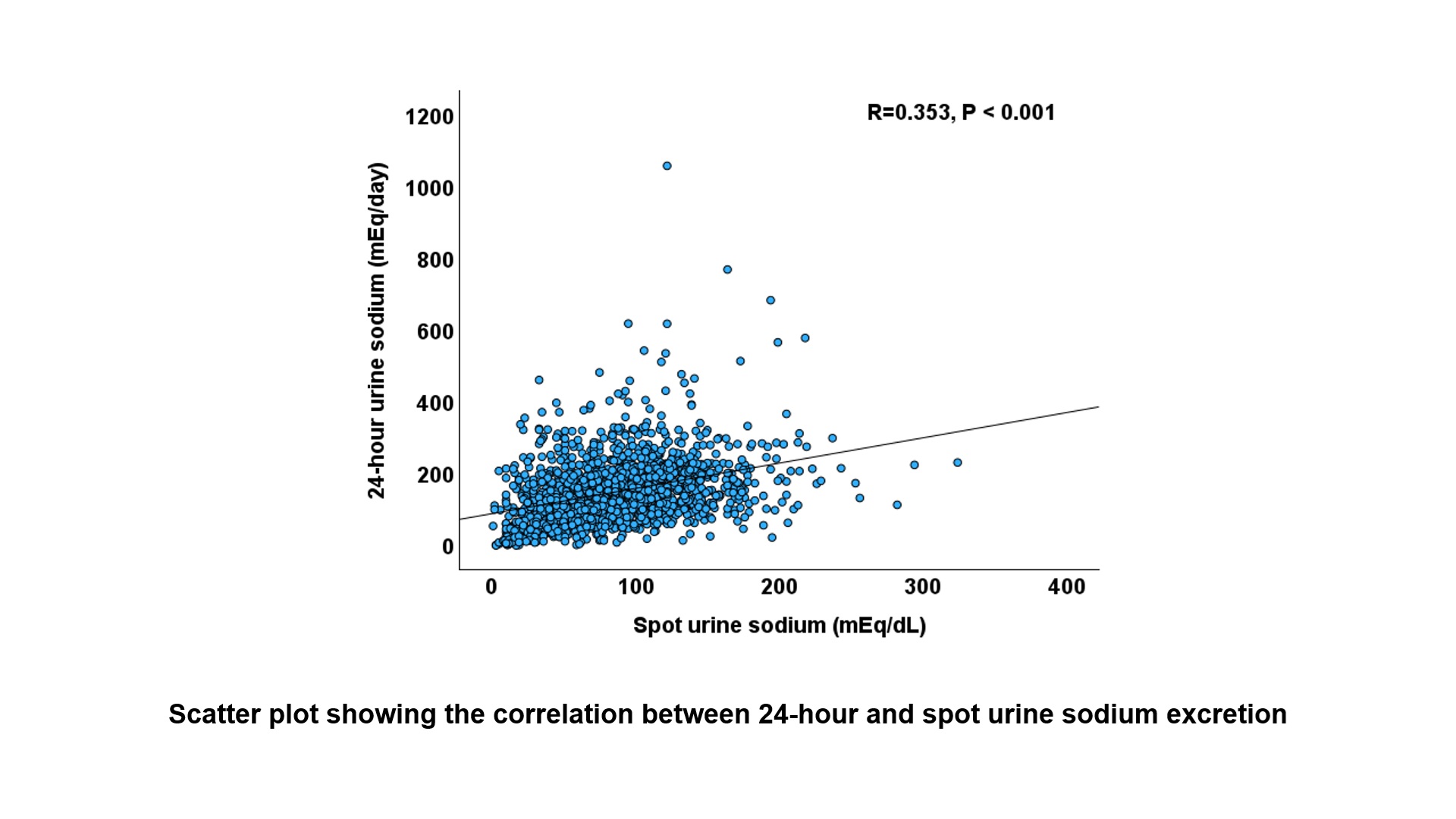
Scatter plot of 24hUNa.jpg
Scatter plot of 24hUNa.jpg