Abstract Type : Oral presentation
Abstract Submission No.: A-0678
Abstract Topic : Non-dialysis CKD
Elucidating the Genetic Landscape of End-Stage Renal Disease: Genome-Wide Association and Multi-Polygenic Risk Score Analyses
Omi Na1, Hee Jung Jeon2, Hyung Woo Kim1, Young Jin Kim3, Jaeseok Yang1
1Department of Internal Medicine-Nephrology, Severance Hospital, Korea, Republic of
2Department of Internal Medicine, Kangdong Sacred Heart Hospital, Korea, Republic of
3Department of Division of Genome Science, Department of Precision Medicine, National Institute of Health, Cheongju-si, Korea, Republic of
Objectives : End-stage renal disease (ESRD) represents the irreversible stage of kidney failure, yet its genetic architecture remains incompletely defined compared to chronic kidney disease (CKD). While prior studies largely focused on kidney function traits, the genetic determinants of ESRD itself and its etiologic subtypes are poorly understood. Therefore, this study aimed to identify genetic loci associated with ESRD and its subtypes and to evaluate the predictive utility of multiple polygenic risk scores (PRSs) for stratifying ESRD risk.
Methods : We performed a large-scale genome-wide association study (GWAS) using a dataset of 2,355 ESRD patients from the Korean Organ Transplantation Registry (KOTRY) across three subtypes defined by primary disease, along with 152,131 controls from the Korean Genome Epidemiology Study (KoGES). Genotyping was performed with the Korea Biobank Array, followed by quality control, imputation, and association testing. PRSs for type 2 diabetes, hypertension, estimated glomerular filtration rate (eGFR), and chronic renal failure were calculated, and a multi-PRS model was derived.
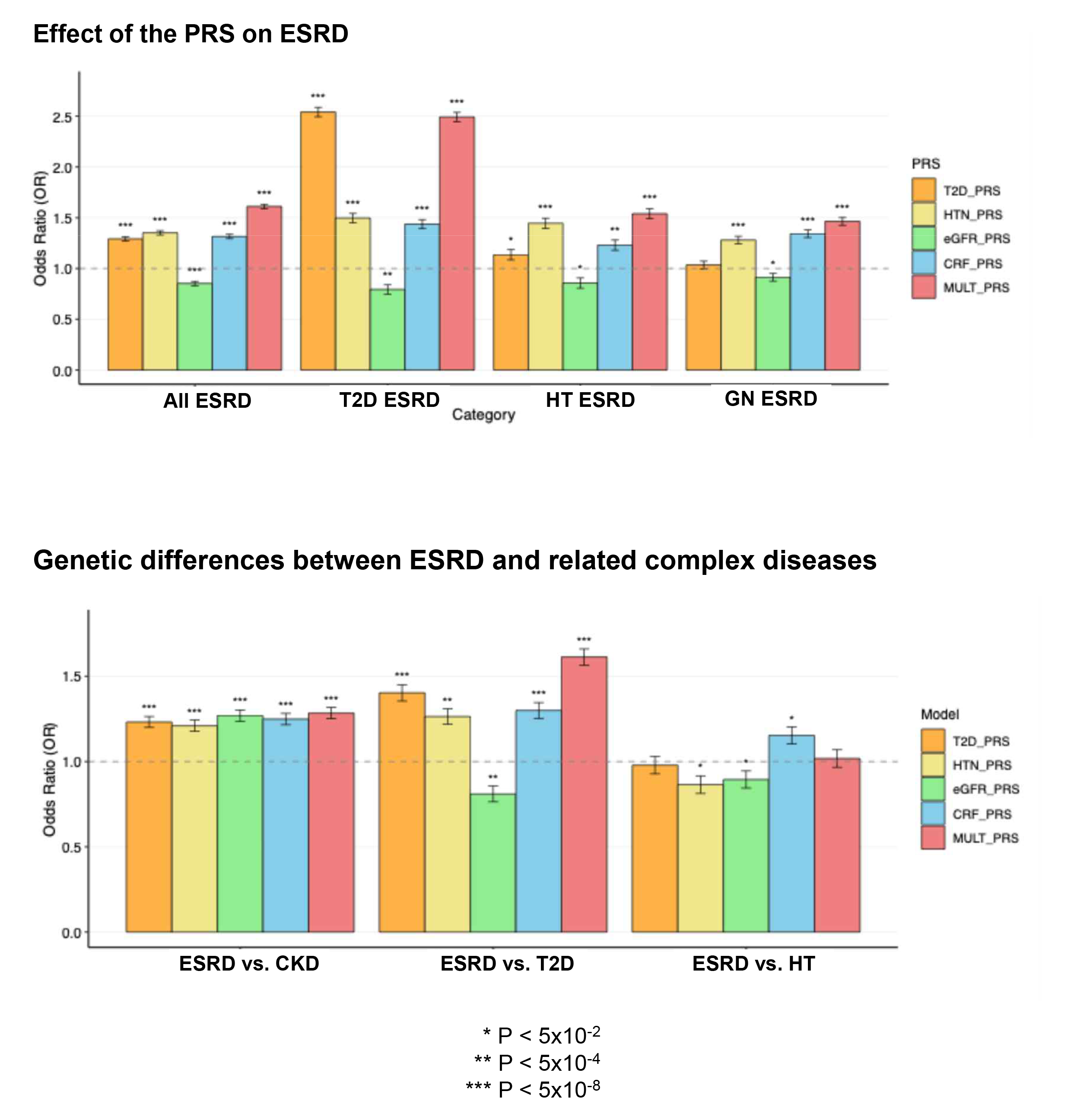
Results : The GWAS identified multiple ESRD-associated loci, including HLA-DRB1 for all ESRD and glomerulonephritis as a primary disease, KCNQ1 for diabetic ESRD, and COL24A1 for hypertensive ESRD at the genome-wide significance (P<5x10⁻⁸), implicating distinct immune and hypertension-related pathways in ESRD pathogenesis. PRS analysis revealed that genetically distinct components of type 2 diabetes, hypertension, chronic renal failure, and eGFR were significantly linked to ESRD risk across subtypes (OR=1.1–2.5). A combined multi-PRS model demonstrated superior predictive performance (OR=1.5–2.5). Comparison with CKD cohorts, predominantly influenced by eGFR-related genetics, uncovered unique ESRD-specific genetic signatures, highlighting ESRD as a genetically heterogeneous and multifactorial disease beyond CKD.
Conclusions : This study identified novel subtype-specific loci and demonstrated that multi-PRS models substantially improve ESRD risk prediction beyond clinical factors. These findings provide a foundation for etiology-specific genetic risk stratification and personalized management strategies in ESRD.
Methods : We performed a large-scale genome-wide association study (GWAS) using a dataset of 2,355 ESRD patients from the Korean Organ Transplantation Registry (KOTRY) across three subtypes defined by primary disease, along with 152,131 controls from the Korean Genome Epidemiology Study (KoGES). Genotyping was performed with the Korea Biobank Array, followed by quality control, imputation, and association testing. PRSs for type 2 diabetes, hypertension, estimated glomerular filtration rate (eGFR), and chronic renal failure were calculated, and a multi-PRS model was derived.
Results : The GWAS identified multiple ESRD-associated loci, including HLA-DRB1 for all ESRD and glomerulonephritis as a primary disease, KCNQ1 for diabetic ESRD, and COL24A1 for hypertensive ESRD at the genome-wide significance (P<5x10⁻⁸), implicating distinct immune and hypertension-related pathways in ESRD pathogenesis. PRS analysis revealed that genetically distinct components of type 2 diabetes, hypertension, chronic renal failure, and eGFR were significantly linked to ESRD risk across subtypes (OR=1.1–2.5). A combined multi-PRS model demonstrated superior predictive performance (OR=1.5–2.5). Comparison with CKD cohorts, predominantly influenced by eGFR-related genetics, uncovered unique ESRD-specific genetic signatures, highlighting ESRD as a genetically heterogeneous and multifactorial disease beyond CKD.
Conclusions : This study identified novel subtype-specific loci and demonstrated that multi-PRS models substantially improve ESRD risk prediction beyond clinical factors. These findings provide a foundation for etiology-specific genetic risk stratification and personalized management strategies in ESRD.
Figure.png