Abstract Type : Oral presentation
Abstract Submission No.: A-0632
Abstract Topic : Non-dialysis CKD
Long-Term Effects of Ambient Ozone on Mortality and Cardiovascular Outcomes in a Nationwide Cohort of Over One Million Patients with Chronic Kidney Disease
Seung Hyun Han1, Hyemin Jang2, Yunwoo Roh3, Jin Kyung Kwon5, Seoyeong Ahn3, Whanhee Lee3, Yon Su Kim4, Chun Soo Lim6, Ho Kim2, Jung Pyo Lee6
1Department of Internal Medicine-Nephrology, Inje University Ilsan Paik Hospital, Korea, Republic of
2Department of Department of Public Health Sciences, Graduate School of Public health, Seoul National University College of Medicine, Korea, Republic of
3Department of School of Biomedical Convergence Engineering, Pusan National University, Korea, Republic of
4Department of Internal Medicine-Nephrology, Seoul National University Hospital, Korea, Republic of
5Department of Internal Medicine-Nephrology, Keimyung University Dongsan Medical Center, Korea, Republic of
6Department of Internal Medicine-Nephrology, Seoul National University Boramae Medical Center, Korea, Republic of
Methods : This nationwide, population-based cohort study was conducted using Korean National Health Insurance data linked to district-level ozone estimates aggregated from 1 km2-resolution prediction models. We included 1,077,740 adults with CKD without prior hospitalizations for cardiovascular or kidney disease and followed them from 2015 to 2023. Long-term ozone exposure was defined according to a two-year moving average (lag: 0–1 year). Cox models with time-varying covariates were used to estimate adjusted hazard ratios (HRs) per 10 ppb increase in ozone for all-cause mortality, major adverse cardiovascular events (MACE), end-stage kidney disease (ESKD), and kidney-related hospitalizations. Subgroup, sensitivity, and lag-structure analyses were used to assess model robustness.
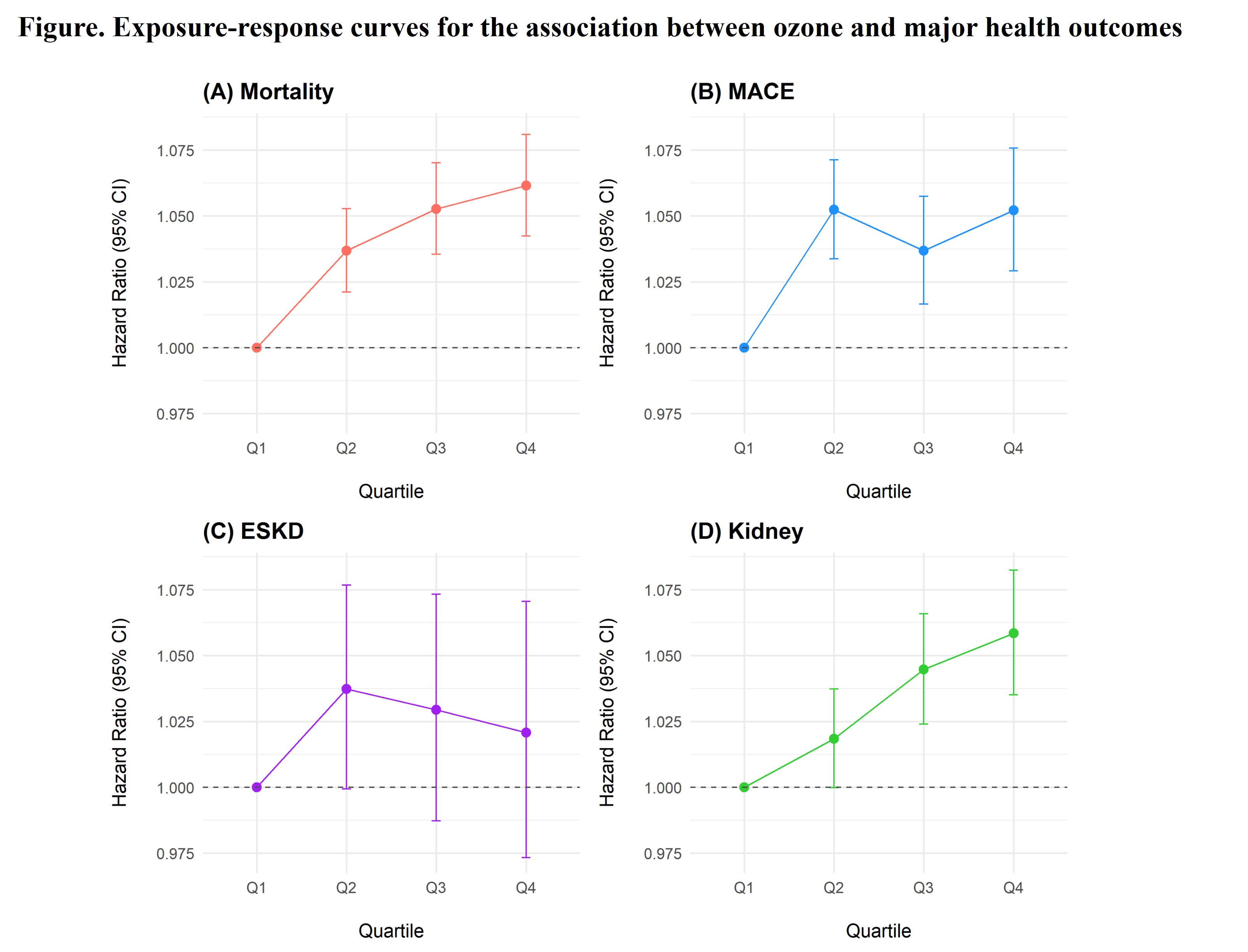
Results : During a median follow-up of 9 years, higher ozone concentrations were associated with increased risks of mortality (HR: 1.083; 95% CI: 1.060–1.106), MACE (HR: 1.060; 95% CI: 1.033–1.087), and kidney-related hospital admissions (HR: 1.099; 95% CI: 1.071–1.127). The associations were consistent across exposure lags, and the strongest effect estimates were observed in component outcomes for heart failure, AKI, and UTIs. The effects were more pronounced in older, low-income, hypertensive, and diabetic individuals.
Conclusions : Long-term ozone exposure is associated with adverse clinical outcomes (including mortality, cardiovascular events, and kidney-related hospitalizations) in patients with CKD. These findings highlight ozone as an underrecognized environmental risk factor with important implications for protecting vulnerable populations.
fig_ozone1.jpg