Abstract Type : Oral presentation
Abstract Submission No.: A-0630
Abstract Topic : Dialysis
Serial Metabolic Changes and Peritoneal NAMPT as Predictors of Peritonitis in Peritoneal Dialysis: A 5-Year Prospective Cohort Study
Seonha Lee, Hayo Jang, Ho Jeong Kim, Dae Ryong Cha, Jin Joo Cha, Young Sun Kang
Department of Internal Medicine-Nephrology, Korea University Ansan Hospital, Korea, Republic of
Objectives : Peritoneal dialysis–associated peritonitis remains a major complication in patients undergoing peritoneal dialysis (PD). While systemic inflammatory markers have been extensively studied, the impact of serial metabolic changes and local peritoneal biomarkers on peritonitis susceptibility remains unclear.
Methods : This study was a prospective observational cohort designed to evaluate the association between 5-year changes and variability in clinical parameters and subsequent clinical outcomes. Ninety-four clinically stable PD patients were enrolled. Exposure variables included serial changes in HbA1c, body mass index (BMI), body composition parameters, and serum and peritoneal NAMPT levels. Primary outcome was PD-associated peritonitis, and secondary outcomes included hospitalization, cardiovascular events, and mortality. Multivariable logistic regression and linear mixed-effects models were used.
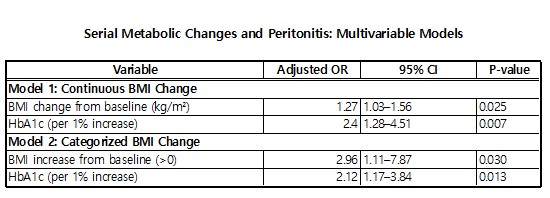
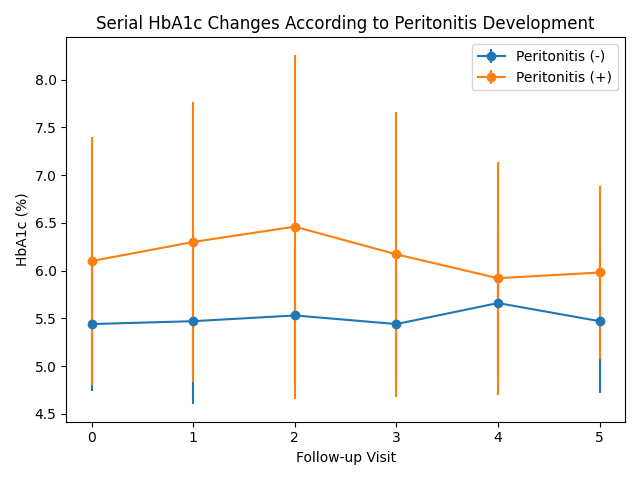
Results : During follow-up, 48 patients developed peritonitis, 78 were hospitalized, 7 experienced cardiovascular events, and 10 died. Higher HbA1c levels and increases in BMI from baseline were independently associated with peritonitis development. Higher HbA1c levels were consistently observed in the peritonitis group throughout follow-up. Peritoneal NAMPT levels were significantly lower in patients who developed peritonitis. Baseline peritoneal NAMPT levels were significantly associated with subsequent peritonitis in longitudinal mixed-model analyses (p = 0.032), whereas serum NAMPT levels did not differ between groups.
Conclusions : Serial metabolic deterioration, particularly worsening glycemic control and weight gain, was associated with PD-associated peritonitis. Lower baseline peritoneal NAMPT levels may reflect vulnerability of the local peritoneal metabolic–immune environment, suggesting its potential role as a local biomarker of peritonitis susceptibility.
Methods : This study was a prospective observational cohort designed to evaluate the association between 5-year changes and variability in clinical parameters and subsequent clinical outcomes. Ninety-four clinically stable PD patients were enrolled. Exposure variables included serial changes in HbA1c, body mass index (BMI), body composition parameters, and serum and peritoneal NAMPT levels. Primary outcome was PD-associated peritonitis, and secondary outcomes included hospitalization, cardiovascular events, and mortality. Multivariable logistic regression and linear mixed-effects models were used.
Results : During follow-up, 48 patients developed peritonitis, 78 were hospitalized, 7 experienced cardiovascular events, and 10 died. Higher HbA1c levels and increases in BMI from baseline were independently associated with peritonitis development. Higher HbA1c levels were consistently observed in the peritonitis group throughout follow-up. Peritoneal NAMPT levels were significantly lower in patients who developed peritonitis. Baseline peritoneal NAMPT levels were significantly associated with subsequent peritonitis in longitudinal mixed-model analyses (p = 0.032), whereas serum NAMPT levels did not differ between groups.
Conclusions : Serial metabolic deterioration, particularly worsening glycemic control and weight gain, was associated with PD-associated peritonitis. Lower baseline peritoneal NAMPT levels may reflect vulnerability of the local peritoneal metabolic–immune environment, suggesting its potential role as a local biomarker of peritonitis susceptibility.
Serial_HbA1c_Peritonitis.png
Serial_HbA1c_Peritonitis.png