Abstract Type : Poster exhibition
Abstract Submission No.: A-0567
Abstract Topic : Glomerular and Tubulointerstitial Disorders
Unbiased Transcriptomic Clustering Identifies a STAT1-Driven Inflammatory PEC Endotype at the Glomerular Vascular Pole
Jeong Ho Joo1, Sehoon Park2, Dong Ki Kim2, Jeong Seok Lee1
1Department of Internal Medicine, KAIST, Korea, Republic of
2Department of Internal Medicine-Nephrology, Seoul National University College of Medicine, Korea, Republic of
Objectives : Glomerular diseases are traditionally classified based on histopathologic features derived from kidney biopsy, yet patients within the same diagnostic category often exhibit heterogenous molecular programs and clinical outcomes. We aimed to define transcriptome-based disease endotypes of glomerular diseases using single-nucleus RNA sequencing (snRNA-seq) and an unbiased clustering framework integrating transcriptomic signals across kidney cell types.
Methods : snRNA-seq on treatment-naïve human kidney biopsies and developed a pseudobulk-based unified clustering framework integrating transcriptomic profiles across major kidney cell types. The approach was applied to 42 samples including minimal change disease, membranous nephropathy, IgA nephropathy, focal segmental glomerulosclerosis, diabetic kidney disease, and healthy controls.
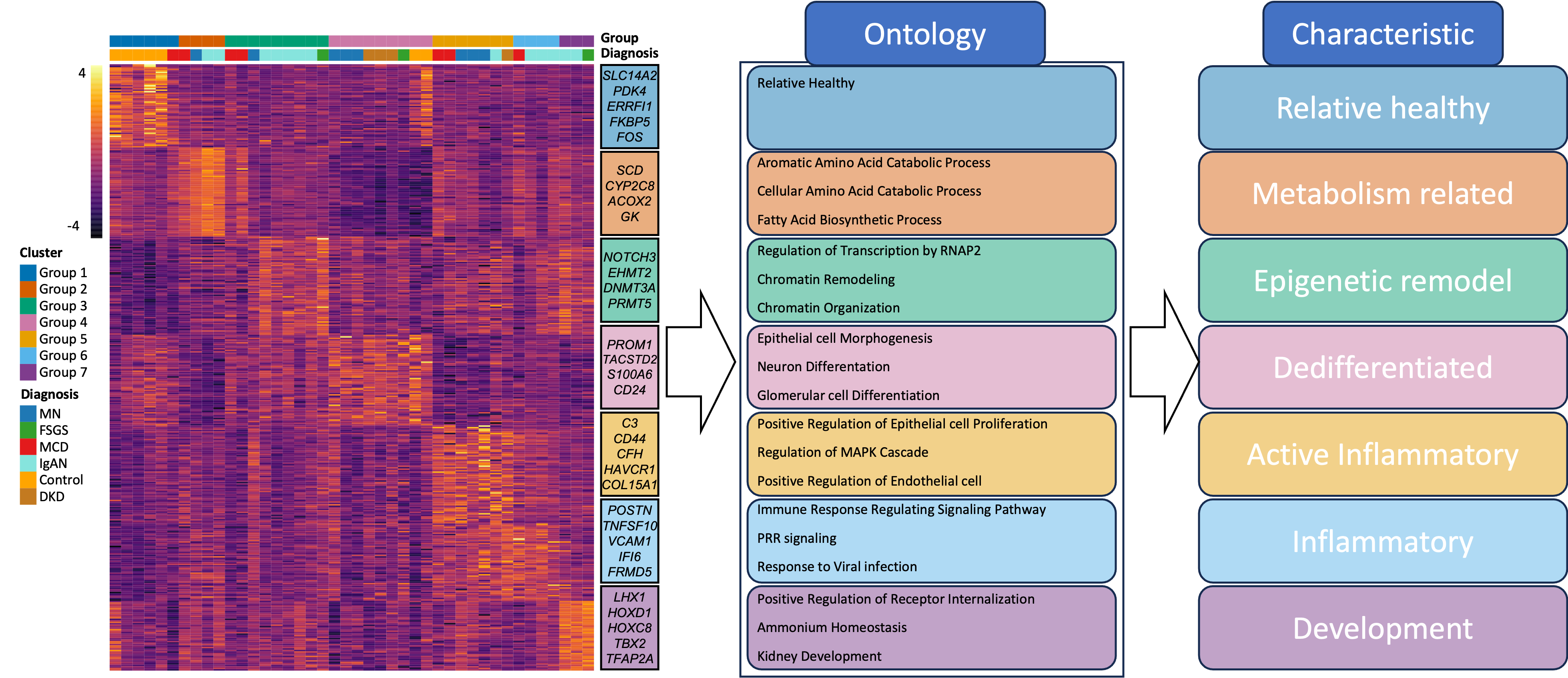
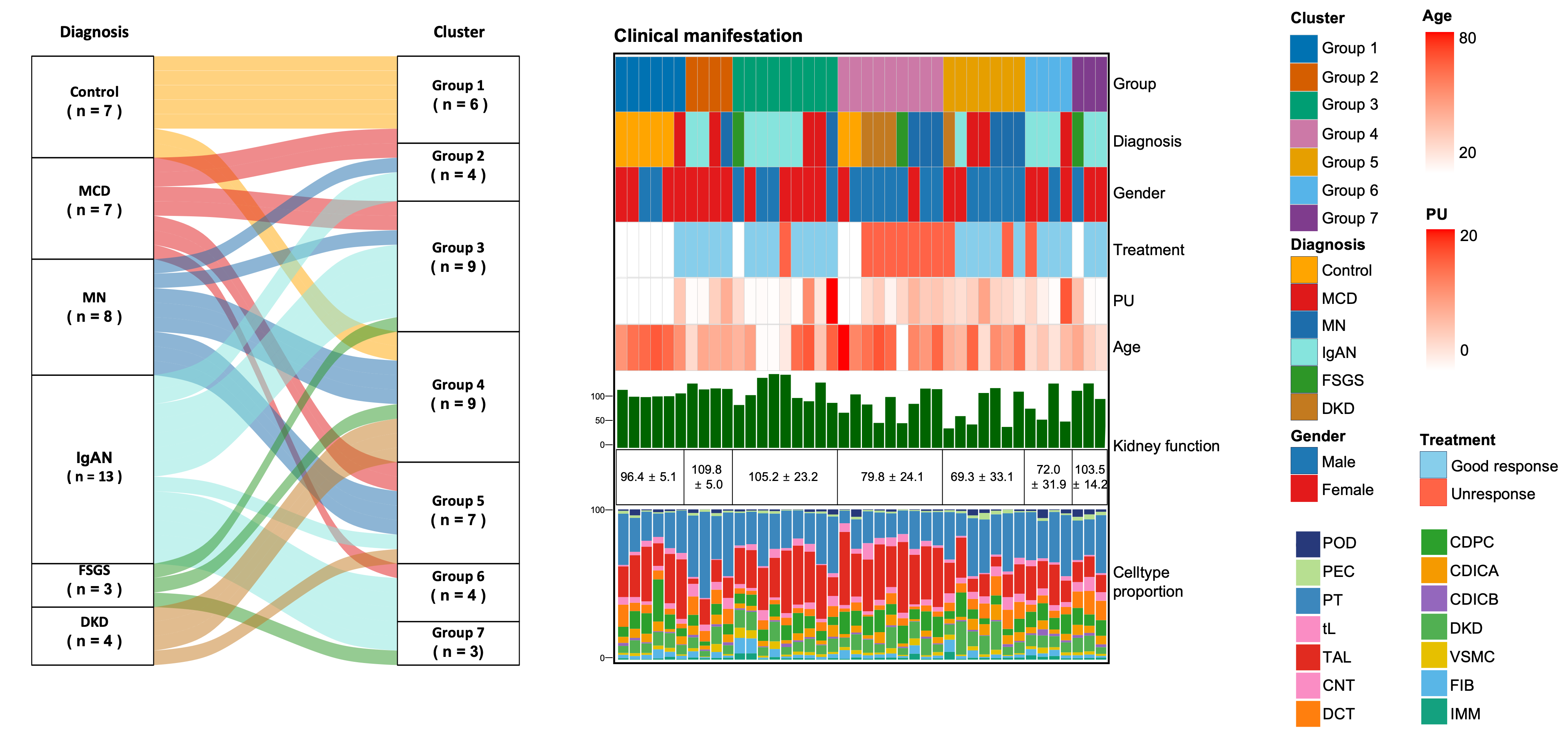
Results : Unbiased clustering identified seven transcriptomic endotypes that transcended conventional diagnostic boundaries. Group 2 represented a metabolically adaptive state dominated by proximal tubule programs, characterized by activation of PPARα-driven fatty acid oxidation and suppression of Wnt and NF-κB signaling, consistent with a low-inflammatory epithelial response to injury. In contrast, Group 4 showed widespread epithelial dedifferentiation and activation of regenerative programs across nephron segments. Notably, Group 5 emerged as a distinct inflammatory endotype centered on parietal epithelial cells (PECs), marked by expansion of an activated PEC population expressing chemokines and sclerosis-associated markers including CD44. Gene regulatory network analysis revealed strong enrichment of STAT1-centered regulons, indicating interferon-driven inflammatory signaling. Spatial transcriptomic analysis demonstrated preferential localization of activated PECs to the glomerular vascular pole, where coordinated activation of renin–angiotensin–aldosterone system related genes was observed in adjacent macula densa–like and juxtaglomerular cell populations.
Conclusions : Transcriptome-based, cell type–resolved clustering reveals biologically coherent glomerular disease endotypes that are not captured by conventional histologic classification. In particular, we identify a STAT1-associated inflammatory PEC niche coupled to RAAS signaling as a distinct pathogenic state. These findings provide a molecular framework for transcriptome-guided patient stratification and suggest interferon–STAT1 signaling as a potential therapeutic target for a subset of glomerular diseases.
Methods : snRNA-seq on treatment-naïve human kidney biopsies and developed a pseudobulk-based unified clustering framework integrating transcriptomic profiles across major kidney cell types. The approach was applied to 42 samples including minimal change disease, membranous nephropathy, IgA nephropathy, focal segmental glomerulosclerosis, diabetic kidney disease, and healthy controls.
Results : Unbiased clustering identified seven transcriptomic endotypes that transcended conventional diagnostic boundaries. Group 2 represented a metabolically adaptive state dominated by proximal tubule programs, characterized by activation of PPARα-driven fatty acid oxidation and suppression of Wnt and NF-κB signaling, consistent with a low-inflammatory epithelial response to injury. In contrast, Group 4 showed widespread epithelial dedifferentiation and activation of regenerative programs across nephron segments. Notably, Group 5 emerged as a distinct inflammatory endotype centered on parietal epithelial cells (PECs), marked by expansion of an activated PEC population expressing chemokines and sclerosis-associated markers including CD44. Gene regulatory network analysis revealed strong enrichment of STAT1-centered regulons, indicating interferon-driven inflammatory signaling. Spatial transcriptomic analysis demonstrated preferential localization of activated PECs to the glomerular vascular pole, where coordinated activation of renin–angiotensin–aldosterone system related genes was observed in adjacent macula densa–like and juxtaglomerular cell populations.
Conclusions : Transcriptome-based, cell type–resolved clustering reveals biologically coherent glomerular disease endotypes that are not captured by conventional histologic classification. In particular, we identify a STAT1-associated inflammatory PEC niche coupled to RAAS signaling as a distinct pathogenic state. These findings provide a molecular framework for transcriptome-guided patient stratification and suggest interferon–STAT1 signaling as a potential therapeutic target for a subset of glomerular diseases.
KSN_2026.png
KSN_2026.png