Abstract Type : Oral presentation
Abstract Submission No.: A-0492
Abstract Topic : Glomerular and Tubulointerstitial Disorders
Soluble CD93 Mediates Podocyte Injury Through Activation of the TGF- Pathway in Idiopathic Nephrotic Syndrome
Md Imtiazul Islam1, Audrey Fetsko1, Xin Wang1, Timothy Cummins2, Gabriel Cara-Fuentes1
1Department of The Kidney and Urinary Tract Center, Nationwide Children's Hospital, United States
2Department of Medicine, University of Louisville, United States
Objectives : Idiopathic nephrotic syndrome (INS) is considered a non‑inflammatory, autoimmune podocytopathy driven by podocyte‑specific autoantibodies. However, increasing evidence suggests endothelial involvement in INS. We recently identified that patients with INS exhibit high urinary levels of soluble CD93 (sCD93), an endothelial‑derived molecule, and elevated urinary sCD93 correlates with unfavorable long‑term kidney outcomes. We also showed that sCD93 activates cultured human podocytes through β1 integrin–FAK signaling and that CD93 blockade markedly reduces proteinuria, podocyte loss, and glomerulosclerosis in vivo. These findings link sCD93 to podocyte injury and disease progression, but the downstream pathways remain unclear. Therefore, the objective of the present study was to identify and characterize the downstream pathways regulated by sCD93 in podocytes.
Methods : To identify pathways involved in podocyte injury in human INS, we integrated transcriptomic (total RNA‑seq) and phosphoproteomic profiling of cultured human podocytes exposed to recombinant CD93 (rCD93). Based on these datasets, the most biologically relevant pathway was selected for further study. Key targets were validated using in vitro approaches including western blot, co‑immunoprecipitation (co‑IP), immunofluorescence (IF), and electric cell‑substrate impedance sensing (ECIS), as well as in vivo analyses such as immunohistochemistry (IHC).
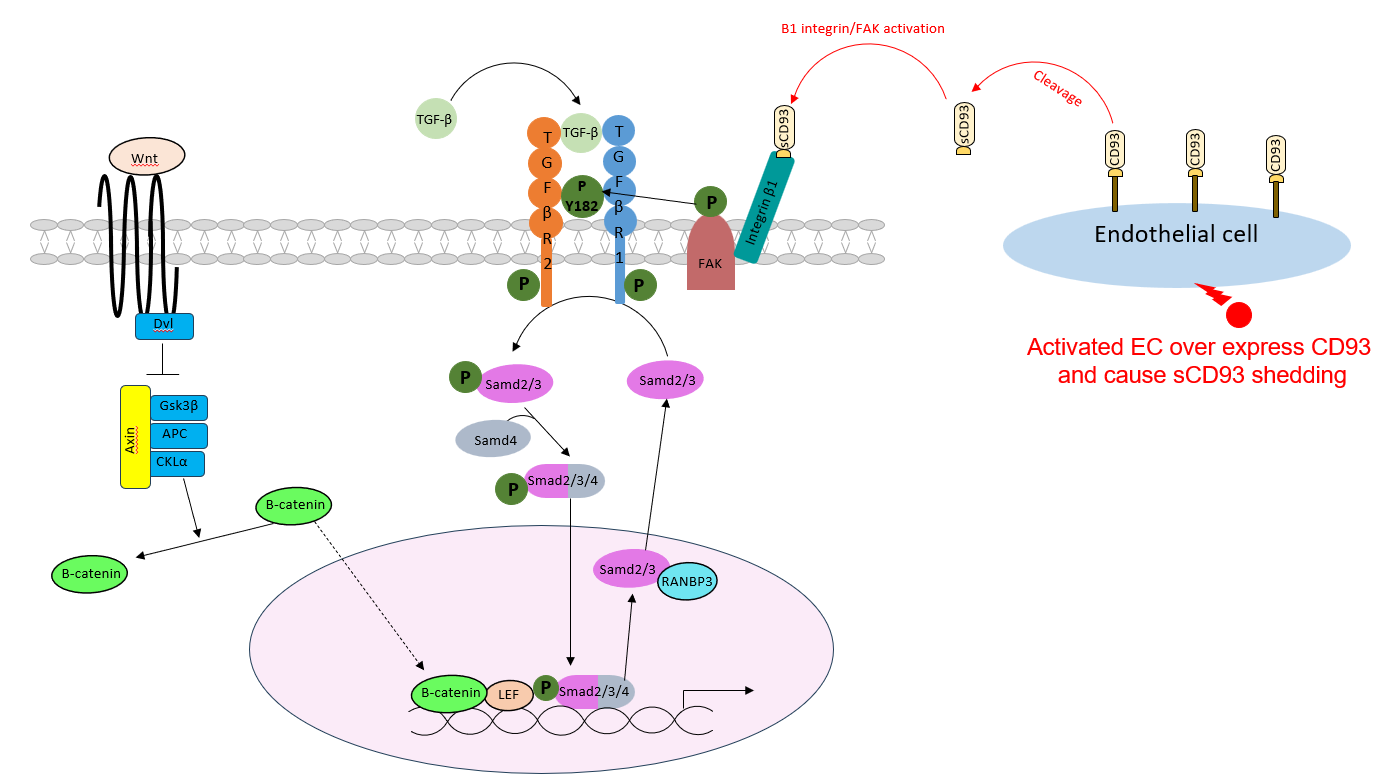
Results : Bulk RNA sequencing identified 394 differentially expressed genes in rCD93‑treated podocytes compared with controls, including transcripts previously implicated in kidney fibrosis and FSGS, such as CXCL14 and CTNNB1. Phosphoproteomics revealed changes in phosphoproteins overlapping with RNA‑seq findings, including components of the TGFβ pathway such as RANBP3 and β‑catenin. Co‑IP studies showed that rCD93 binds to β1 integrin, and western blot analysis confirmed activation of FAK, demonstrated by increased p‑FAK, and induction of the TGFβ pathway, evidenced by elevated p‑Smad2 and p‑Ranbp3 in rCD93‑treated podocytes. Importantly, β1‑integrin–blocking antibody significantly ameliorated rCD93‑induced TGFβ activation in podocytes.
Conclusions : These findings indicate that sCD93 induces podocyte injury by activating the TGFβ pathway through β1 integrin/FAK signaling.
Methods : To identify pathways involved in podocyte injury in human INS, we integrated transcriptomic (total RNA‑seq) and phosphoproteomic profiling of cultured human podocytes exposed to recombinant CD93 (rCD93). Based on these datasets, the most biologically relevant pathway was selected for further study. Key targets were validated using in vitro approaches including western blot, co‑immunoprecipitation (co‑IP), immunofluorescence (IF), and electric cell‑substrate impedance sensing (ECIS), as well as in vivo analyses such as immunohistochemistry (IHC).
Results : Bulk RNA sequencing identified 394 differentially expressed genes in rCD93‑treated podocytes compared with controls, including transcripts previously implicated in kidney fibrosis and FSGS, such as CXCL14 and CTNNB1. Phosphoproteomics revealed changes in phosphoproteins overlapping with RNA‑seq findings, including components of the TGFβ pathway such as RANBP3 and β‑catenin. Co‑IP studies showed that rCD93 binds to β1 integrin, and western blot analysis confirmed activation of FAK, demonstrated by increased p‑FAK, and induction of the TGFβ pathway, evidenced by elevated p‑Smad2 and p‑Ranbp3 in rCD93‑treated podocytes. Importantly, β1‑integrin–blocking antibody significantly ameliorated rCD93‑induced TGFβ activation in podocytes.
Conclusions : These findings indicate that sCD93 induces podocyte injury by activating the TGFβ pathway through β1 integrin/FAK signaling.
GA .png