Abstract Type : Oral presentation
Abstract Submission No.: A-0476
Abstract Topic : Diabetic Kidney Disease + Metabolic Abnormality-related Kidney Disease
Finerenone Reduces Urinary Biomarkers of Tubular Injury and Mitochondrial Stress Independent of Albuminuria Response
Kootae Park1, Soon Hyo Kwon2, Haekyung Lee2, Hyoungnae Kim2, Jin Seok Jeon2, Hyunjin Noh2
1Department of Internal Medicine-Nephrology, Soonchunhyang University Gumi Hospital, Korea, Republic of
2Department of Internal Medicine-Nephrology, Soonchunhyang University Seoul Hospital, Korea, Republic of
Objectives : Finerenone, a non-steroidal mineralocorticoid receptor antagonist, has demonstrated substantial cardio-renal protective effects in patients with diabetic kidney disease (DKD). While finerenone’s albuminuria-lowering effect is a key clinical endpoint, it remains uncertain whether its impact on tubular injury and mitochondrial stress is coupled with the degree of albuminuria reduction. This study aimed to evaluate whether finerenone improves urinary biomarkers of tubular injury and mitochondrial dysfunction in patients with DKD, independent of its albuminuria-lowering effect.
Methods : In this prospective study, we enrolled 45 patients with DKD receiving finerenone and 20 healthy volunteers (HVs). At baseline and after 6 months of treatment, we measured urinary biomarkers of tubular injury (KIM-1/Cr and IL-18/Cr) and mitochondrial stress markers (LnND1 and LnCox3). Albuminuria response was defined as a ≥30% reduction in the urinary albumin-to-creatinine ratio (uACR) at 6 months from baseline. Based on this criterion, patients were stratified into the albuminuria reduction group (n=28) and a no-reduction group (n=17).
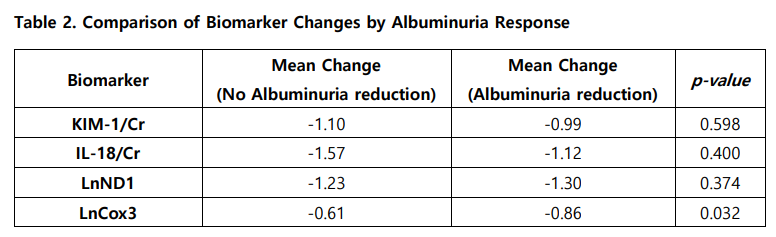
Results : At baseline, patients with DKD exhibited significantly higher levels of urinary biomarkers of tubular injury and mitochondrial stress compared with HVs. After 6 months of finerenone therapy, significant reductions were observed in all measured urinary biomarkers (all p<0.001). Importantly, both the albuminuria reduction group and no-reduction group demonstrated significant decreases in these biomarkers. The magnitude of reduction in KIM-1/Cr, IL-18/Cr, and LnND1 was comparable between the two groups, although the decrease in LnCox3 was more pronounced in the albuminuria reduction group than in no-reduction group (p=0.032).
Conclusions : Finerenone significantly reduced urinary biomarkers of tubular injury and mitochondrial stress in patients with DKD, irrespective of albuminuria response. These findings suggest that the renoprotective effects of finerenone extend beyond its albuminuria-lowering effect, providing strong evidence to support the continued use of finerenone even in patients who do not achieve a substantial reduction in albuminuria.
Methods : In this prospective study, we enrolled 45 patients with DKD receiving finerenone and 20 healthy volunteers (HVs). At baseline and after 6 months of treatment, we measured urinary biomarkers of tubular injury (KIM-1/Cr and IL-18/Cr) and mitochondrial stress markers (LnND1 and LnCox3). Albuminuria response was defined as a ≥30% reduction in the urinary albumin-to-creatinine ratio (uACR) at 6 months from baseline. Based on this criterion, patients were stratified into the albuminuria reduction group (n=28) and a no-reduction group (n=17).
Results : At baseline, patients with DKD exhibited significantly higher levels of urinary biomarkers of tubular injury and mitochondrial stress compared with HVs. After 6 months of finerenone therapy, significant reductions were observed in all measured urinary biomarkers (all p<0.001). Importantly, both the albuminuria reduction group and no-reduction group demonstrated significant decreases in these biomarkers. The magnitude of reduction in KIM-1/Cr, IL-18/Cr, and LnND1 was comparable between the two groups, although the decrease in LnCox3 was more pronounced in the albuminuria reduction group than in no-reduction group (p=0.032).
Conclusions : Finerenone significantly reduced urinary biomarkers of tubular injury and mitochondrial stress in patients with DKD, irrespective of albuminuria response. These findings suggest that the renoprotective effects of finerenone extend beyond its albuminuria-lowering effect, providing strong evidence to support the continued use of finerenone even in patients who do not achieve a substantial reduction in albuminuria.
table1.png
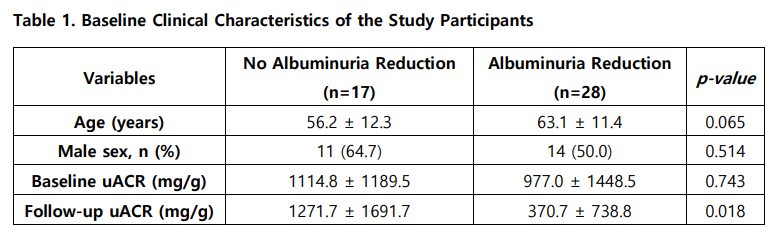
table1.png