Abstract Type : Oral presentation
Abstract Submission No.: A-0445
Abstract Topic : Glomerular and Tubulointerstitial Disorders
Integrated Peripheral and Spatial Single-Cell Multiomics Reveals Immune Remodeling in Minimal Change Disease
Hyunah Ku1, Minji Kang1, Hyun Je Kim1, Dong Ki Kim2, Sehoon Park2
1Department of Department of Biomedical Sciences, Seoul National University College of Medicine, Korea, Republic of
2Department of Internal Medicine-Nephrology, Seoul National University Hospital, Korea, Republic of
Objectives : Minimal Change Disease (MCD) is a primary glomerulonephritis characterized by massive proteinuria due to podocyte foot process effacement. While it generally responds well to immunosuppressive therapy, its molecular pathogenesis remains unclear. We aimed to identify transcriptomic biomarkers and immune features associated with MCD using multi-omics data.
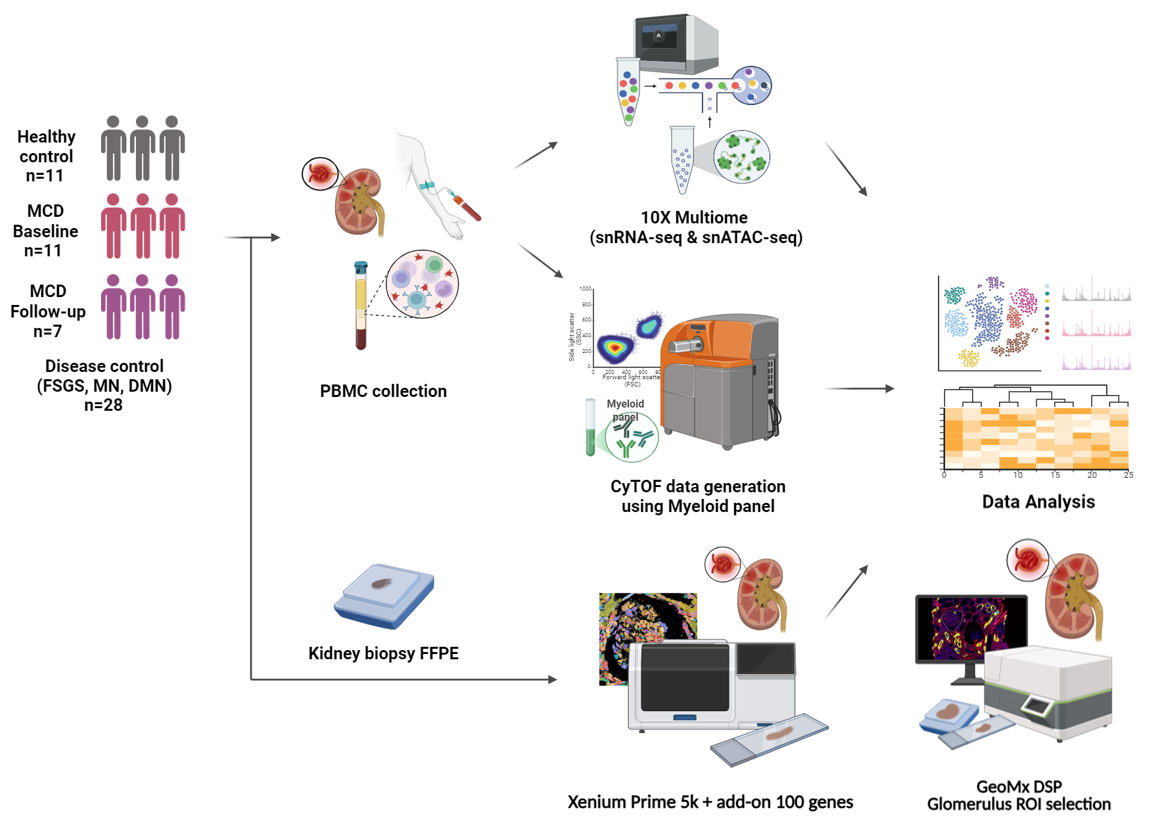
Methods : PBMCs were obtained from 18 MCD patients (11 baseline, 7 follow-up), 4 Focal Segmental Glomerulosclerosis (FSGS) patients, 16 Membranous Nephropathy (MN) patients, 8 Diabetic Nephropathy (DMN) patients, and 11 healthy controls (HC). Single-cell Multiome data (scRNA-seq + scATAC-seq) were analyzed using Seurat and R packages for cell type annotation, proportion analysis, and DEG analysis, followed by GO enrichment using ToppGene and STRINGdb. GeoMx spatial transcriptomic data were also analyzed across disease groups. Xenium Prime In Situ with a 100-gene custom panel and CyTOF with a customized myeloid panel are being analyzed to validate immune signatures at spatial and protein levels.
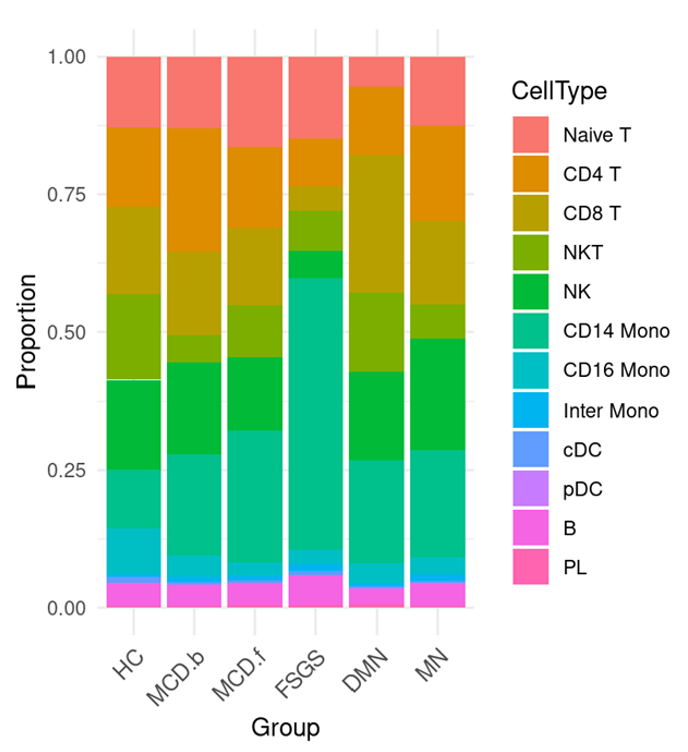
Results : Analysis of GeoMx spatial transcriptomic data revealed increased macrophage activation signals, including CTSS, IL12RB2, IL6, and CSF3, in MCD compared with HC, prompting further investigation of monocytic immune signatures. In PBMC Multiome data, inflammatory CD14⁺ monocytes were increased in both MCD and FSGS compared with HC. However, within disease groups, inflammatory CD14⁺ monocytes were relatively decreased in MCD baseline compared with FSGS and MCD follow-up. In contrast, the MCD baseline group showed a higher proportion of Treg cells compared with HC, FSGS, and MCD follow-up groups.
Conclusions : Early MCD showed increased Tregs and reduced inflammatory CD14⁺ monocytes compared with FSGS, suggesting a shift toward an anti-inflammatory immune state. These findings highlight immune regulatory dynamics along the MCD–FSGS disease spectrum. Ongoing Xenium spatial transcriptomic analysis will enable in situ mapping of target cell localization and potential cell–cell interactions in kidney tissue, while CyTOF analysis will validate circulating immune signatures at the protein level.
Methods : PBMCs were obtained from 18 MCD patients (11 baseline, 7 follow-up), 4 Focal Segmental Glomerulosclerosis (FSGS) patients, 16 Membranous Nephropathy (MN) patients, 8 Diabetic Nephropathy (DMN) patients, and 11 healthy controls (HC). Single-cell Multiome data (scRNA-seq + scATAC-seq) were analyzed using Seurat and R packages for cell type annotation, proportion analysis, and DEG analysis, followed by GO enrichment using ToppGene and STRINGdb. GeoMx spatial transcriptomic data were also analyzed across disease groups. Xenium Prime In Situ with a 100-gene custom panel and CyTOF with a customized myeloid panel are being analyzed to validate immune signatures at spatial and protein levels.
Results : Analysis of GeoMx spatial transcriptomic data revealed increased macrophage activation signals, including CTSS, IL12RB2, IL6, and CSF3, in MCD compared with HC, prompting further investigation of monocytic immune signatures. In PBMC Multiome data, inflammatory CD14⁺ monocytes were increased in both MCD and FSGS compared with HC. However, within disease groups, inflammatory CD14⁺ monocytes were relatively decreased in MCD baseline compared with FSGS and MCD follow-up. In contrast, the MCD baseline group showed a higher proportion of Treg cells compared with HC, FSGS, and MCD follow-up groups.
Conclusions : Early MCD showed increased Tregs and reduced inflammatory CD14⁺ monocytes compared with FSGS, suggesting a shift toward an anti-inflammatory immune state. These findings highlight immune regulatory dynamics along the MCD–FSGS disease spectrum. Ongoing Xenium spatial transcriptomic analysis will enable in situ mapping of target cell localization and potential cell–cell interactions in kidney tissue, while CyTOF analysis will validate circulating immune signatures at the protein level.
KSN_figure1.png
KSN_figure1.png