Abstract Type : Oral presentation
Abstract Submission No.: A-0444
Abstract Topic : Transplantation
Selective Depletion of ABO-Specific B Cells by T Cell-Engaging Bispecific Antibody Conjugates for ABO-Incompatible Kidney Transplantation
Joon Young Jang1, Hyeong Ryeol Choi2, Honglin Piao1, Sang Kook Woo3, Chan Hyuk Kim4, Jaeseok Yang1
1Department of Internal Medicine-Nephrology, Yonsei University College of Medicine, Korea, Republic of
2Department of Department of Biological Sciences, Korea Advanced Institute of Science and Technology, Korea, Republic of
3Department of Department of Chemistry and Chemistry Institute for Functional Materials, Pusan National University, Korea, Republic of
4Department of College of Pharmacy, Seoul National University, Korea, Republic of
Objectives : ABO-incompatible (ABOi) transplantation, developed to expand the donor pool, presents significant clinical challenges of anti-ABO antibody-mediated rejection. Current therapies employing broad B-cell depletion, effectively reduce antibody-mediated rejection but increase infection risks. Therefore, novel strategies to selectively deplete ABO-specific B cells are warranted.
Methods : We developed a novel bispecific antibody-ligand conjugate (BiALC) platform designed to selectively target A-specific B cells. Utilizing synthetic trisaccharide A antigens conjugated to T-cell-recruiting Fab fragments, we optimized BiALC as hexameric construct, (A3-peg)2-anti-(mouse or human) CD3. Mouse or human B cells were cocultured with T cells in the presence of phosphate-buffered saline (PBS), anti-CD20 antibodies, or BiALC to assess selective cytotoxic effects of BiALC. To investigate the in vivo depleting effects of BiALC on A-specific B cells, BALB/c mice sensitized to A antigen, received PBS, anti-CD20 antibodies, or BiALC with or without kidney transplantation from blood group A-transgenic B6 mice.
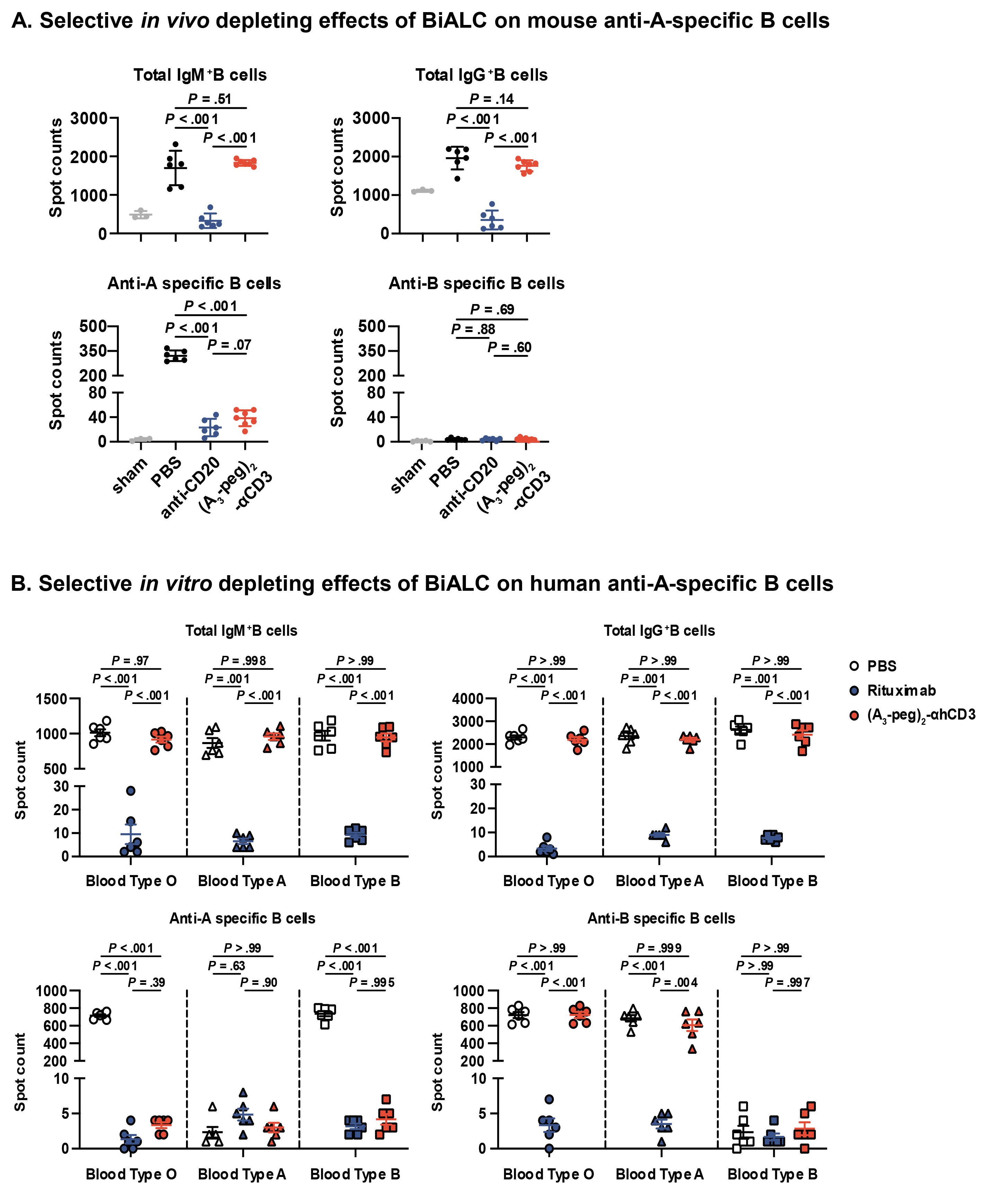
Results : Mouse BiALC enhanced in vitro affinity and cytotoxicity specifically against A antigen-responsive mouse B cells. Similarly, the human BiALC effectively and selectively depleted A-specific human B cells, with potency comparable to rituximab, while sparing total antibody-secreting cells. In parallel, BiALC decreased anti-A IgM and IgG levels in culture supernatant, without affecting total IgM and IgG levels. In murine sensitization models, BiALC selectively depleted A-specific B cells without broadly affecting total B cell populations, preserving overall immune competence. BiALC also decreased serum levels of anti-A IgM and IgG to similar extent as anti-CD20 antibodies. Furthermore, BiALC decreased serum levels of anti-A IgM and IgG after mouse ABOi kidney transplantation. BiALC also suppressed histologic injury scores in kidney allografts to similar extent as anti-CD20 antibodies.
Conclusions : Overall, the BiALC strategy offers a promising antigen-specific approach to reduce rejection risks in ABOi transplantation without inducing broad immunosuppression through nonspecific pan-B cell depletion, supporting its potential for clinical translation.
Methods : We developed a novel bispecific antibody-ligand conjugate (BiALC) platform designed to selectively target A-specific B cells. Utilizing synthetic trisaccharide A antigens conjugated to T-cell-recruiting Fab fragments, we optimized BiALC as hexameric construct, (A3-peg)2-anti-(mouse or human) CD3. Mouse or human B cells were cocultured with T cells in the presence of phosphate-buffered saline (PBS), anti-CD20 antibodies, or BiALC to assess selective cytotoxic effects of BiALC. To investigate the in vivo depleting effects of BiALC on A-specific B cells, BALB/c mice sensitized to A antigen, received PBS, anti-CD20 antibodies, or BiALC with or without kidney transplantation from blood group A-transgenic B6 mice.
Results : Mouse BiALC enhanced in vitro affinity and cytotoxicity specifically against A antigen-responsive mouse B cells. Similarly, the human BiALC effectively and selectively depleted A-specific human B cells, with potency comparable to rituximab, while sparing total antibody-secreting cells. In parallel, BiALC decreased anti-A IgM and IgG levels in culture supernatant, without affecting total IgM and IgG levels. In murine sensitization models, BiALC selectively depleted A-specific B cells without broadly affecting total B cell populations, preserving overall immune competence. BiALC also decreased serum levels of anti-A IgM and IgG to similar extent as anti-CD20 antibodies. Furthermore, BiALC decreased serum levels of anti-A IgM and IgG after mouse ABOi kidney transplantation. BiALC also suppressed histologic injury scores in kidney allografts to similar extent as anti-CD20 antibodies.
Conclusions : Overall, the BiALC strategy offers a promising antigen-specific approach to reduce rejection risks in ABOi transplantation without inducing broad immunosuppression through nonspecific pan-B cell depletion, supporting its potential for clinical translation.
Figure.png