Abstract Type : Oral presentation
Abstract Submission No.: A-0433
Abstract Topic : Transplantation
Clinical Outcomes of Kidney Transplantation from Older Donors: Does Advanced Donor Age Matter? A Nationwide Cohort Study
Jeeyoung Yoon1, Byung Ha Chung 1, Sangil Min2, Kyu ha Huh3, Seun Deuk Hwang4, Jaeseok Yang5, Myoung soo Kim6, Hye Eun Yoon1
1Department of Internal Medicine-Nephrology, The Catholic University of Korea Seoul St. Mary's Hospital , Korea, Republic of
2Department of Surgery, Seoul National University Hospital, Korea, Republic of
3Department of Surgery-Transplantation, Severance Hospital, Korea, Republic of
4Department of Internal Medicine-Nephrology, Inha University Hospital, Korea, Republic of
5Department of Internal Medicine-Nephrology, Severance Hospital, Korea, Republic of
6Department of Surgery, Severance Hospital, Korea, Republic of
Methods : We analyzed 2,205 KTRs who received kidneys from older donors (≥60 years) between April 2014 and December 2023 using a nationwide registry cohort. Recipients were stratified by donor age (60–69 vs. ≥70 years) and recipient age (<60 vs. ≥60 years). Kaplan–Meier analyses with log-rank tests compared all-cause mortality, overall graft failure, death-censored graft failure (DCGF), and biopsy-proven acute rejection (BPAR) rates. Multivariable Cox proportional hazards analysis identified predictors of outcomes expressed as hazard ratios (HRs) with 95% confidence interval (CI).
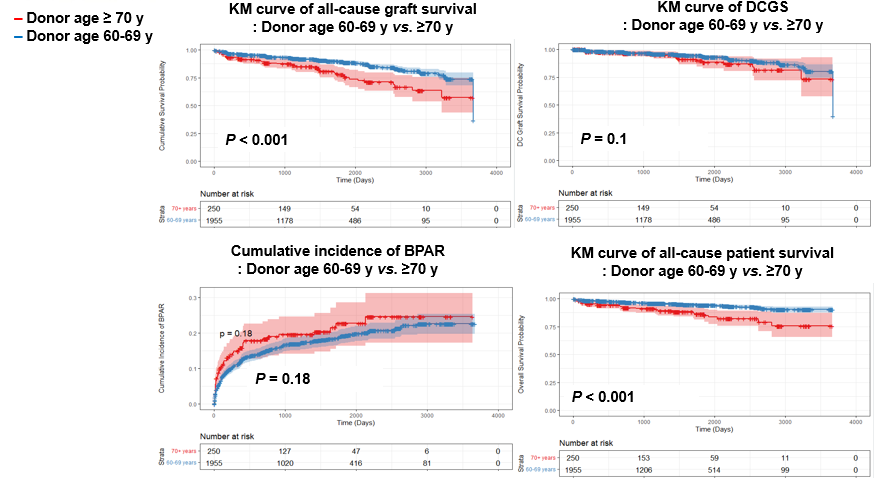
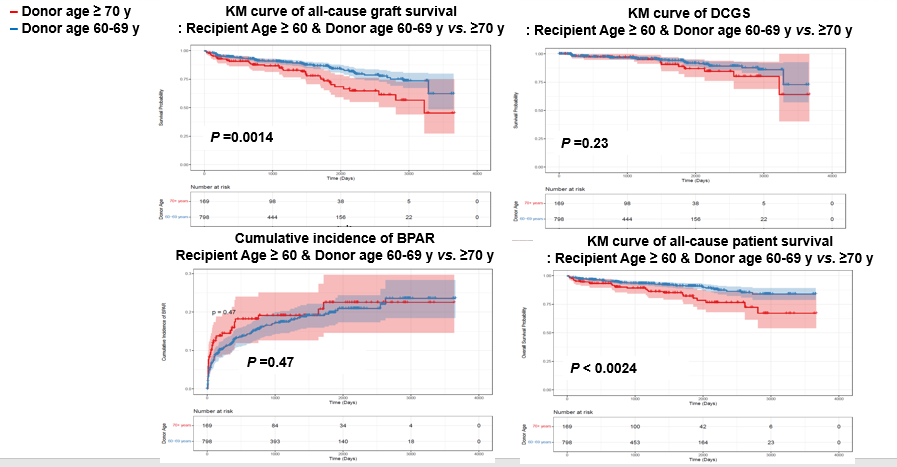
Results : KTRs receiving kidneys from donors ≥70 years (n=250) had higher overall graft failure and mortality than those receiving kidneys from donors aged 60-69 years (n=1,955; both P<0.001), whereas DCGF (P=0.10) and BPAR rates (P=0.18) were similar. Among recipients aged ≥60 years (n=967), overall graft failure (P=0.0014) and mortality (P=0.0024) remained higher in the ≥70-year donor group, while DCGF (P=0.23) and BPAR rates (P=0.47) did not differ. In recipients aged <60 years (n=1,238), outcomes were not significantly different between donor age groups. In multivariable analysis, recipient age independently predicted graft failure (HR, 1.02; 95% CI, 1.00 – 1.03; P=0.03) and mortality (HR, 1.06; 95% CI, 1.05 – 1.11; P<0.001), while advanced donor age was not independently associated with transplant outcomes.
Conclusions : Although advanced-age donors (≥70 years) were associated with lower overall graft and patient survival, particularly among older recipients, graft-specific outcomes were similar between donor age groups. Recipient age, rather than donor age, was a key determinant of post-transplant outcomes. These findings suggest that advanced donor age alone should not preclude kidney utilization.
캡처2.PNG
캡처2.PNG