Abstract Type : Oral presentation
Abstract Submission No.: A-0405
Abstract Topic : Interventional Nephrology
Maturation Outcomes of Arteriovenous Fistula Versus Graft: A Multicenter Prospective Registry Study
Chang Min Park1, Do Hyoung Kim2, Hyung Seok Lee3, Byung Ha Chung4, Young Soo Kim1, Seok Joon Shin5, Hoon Suk Park4
1Department of Internal Medicine-Nephrology, The Catholic University of Korea Uijeongbu St. Mary's Hospital , Korea, Republic of
2Department of Internal Medicine-Nephrology, Kangnam Sacred Heart Hospital, Korea, Republic of
3Department of Internal Medicine-Nephrology, Hallym University Sacred Heart Hospital, Korea, Republic of
4Department of Internal Medicine-Cardiology, The Catholic University of Korea Seoul St. Mary's Hospital , Korea, Republic of
5Department of Internal Medicine-Nephrology, Incheon St. Mary's hospital, The Catholic University of Korea, Korea, Republic of
Methods : This study was a prospective, multicenter (n=21) registry-based study and evaluated patients who underwent AVF or AVG creation between April 2025 and November 2025. The primary outcome was vascular access maturation, assessed by maturation failure and the need for augmentation during maturation. The secondary outcome was defined as catheter insertion after vascular access creation.
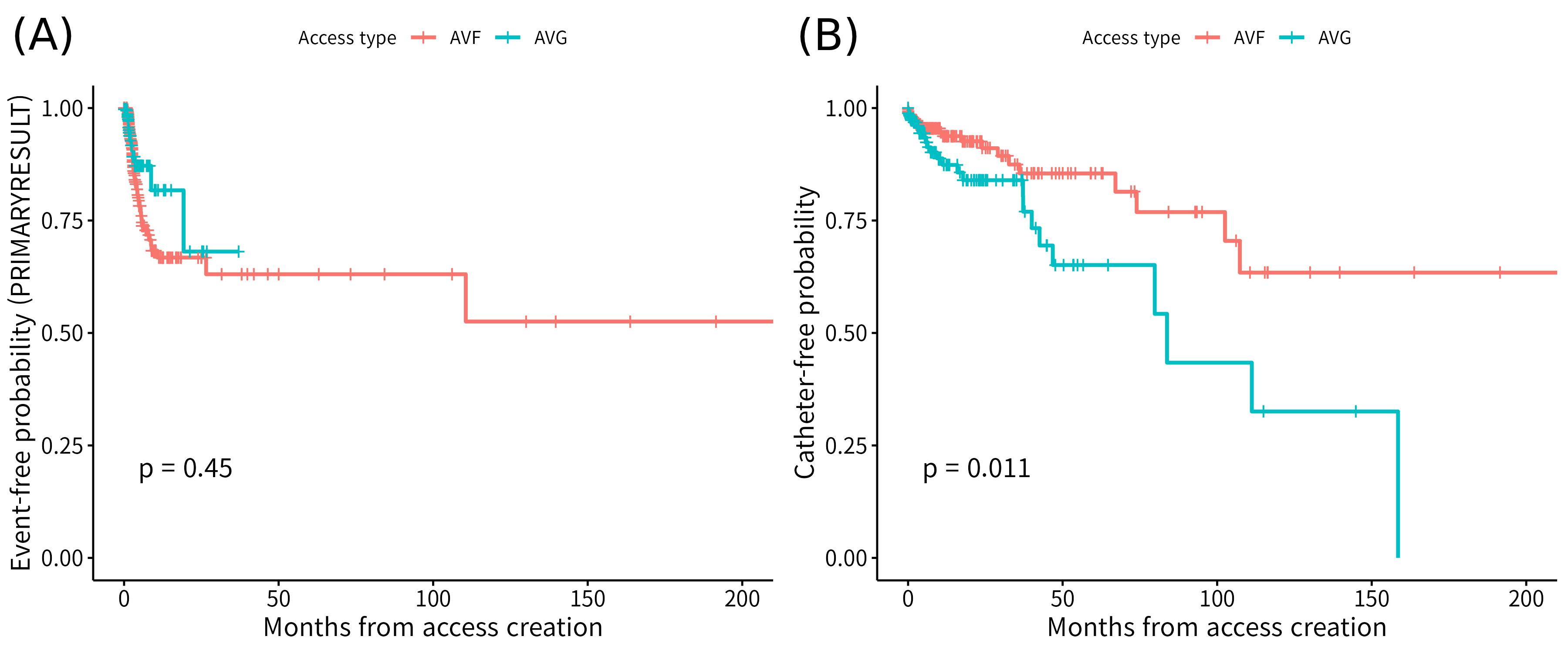
Results : 998 patients were enrolled: 653 (65.4%) in the AVF group and 345 (34.6%) in the AVG group. The overall mean age was 65.95 ± 13.36 years, 43.5% were female, and the mean follow-up duration was 4.53 months. The vascular access maturation rate was 87.7% in the AVF group and 93.9% in the AVG group, while maturation failure was rare in both groups (0.5% and 0.3%, respectively). Augmentation for maturation was required more frequently in the AVF group (11.8% vs. 5.8%, P=0.008, Table 1). Kaplan–Meier analysis showed earlier events in the AVF group; however, no significant difference was observed during the follow-up period (log-rank P=0.45, Figure 1A). Catheter insertion after access creation occurred in 4.9% of the AVF group and 8.7% of the AVG group (P=0.026), and the Kaplan–Meier analysis also showed a significantly higher risk of catheter insertion in the AVG group (log-rank P=0.011, Figure 1B).
Conclusions : AVF was associated with more frequent interventions during maturation but fewer catheter insertions during follow-up, suggesting more stable access function.
Table 1.jpg
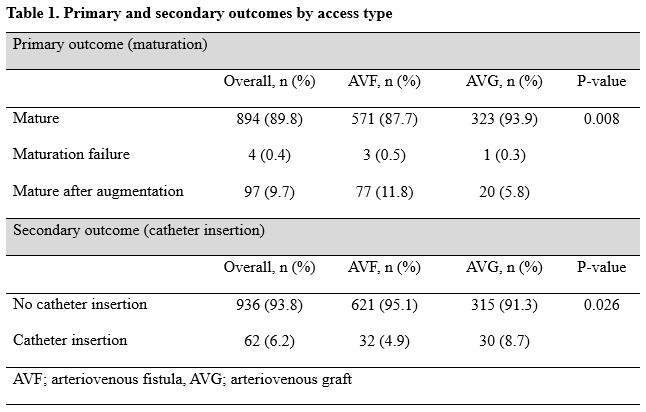
Table 1.jpg