Abstract Type : Oral presentation
Abstract Submission No.: A-0299
Abstract Topic : Basic Research
A Large-Scale Single-Nucleus Transcriptomic Landscape of Major Human Glomerular Diseases
Ara Ko1, Jeong Ho Joo2, Sehoon Park1, Dong Ki Kim1
1Department of Internal Medicine, Seoul National University Hospital, Korea, Republic of
2Department of Graduate School of Medical Science and Engineering, Korea Advanced Institute of Science and Technology, Korea, Republic of
Objectives : Glomerular diseases exhibit significant clinical and transcriptomic heterogeneity, making the understanding of cell-type-specific alterations crucial. We constructed the largest single-nucleus RNA sequencing (snRNA-seq) atlas to elucidate the transcriptomic landscape across multiple human glomerular diseases.
Methods : We analyzed snRNA-seq data from human kidney biopsy cores. Strict quality control included rigorous mitochondrial gene cutoffs suitable for kidney tissues and doublet removal utilizing DoubletFinder. Data normalization was conducted with SCTransform, and batch effects across the extensive cohort were corrected using the Harmony integration algorithm.
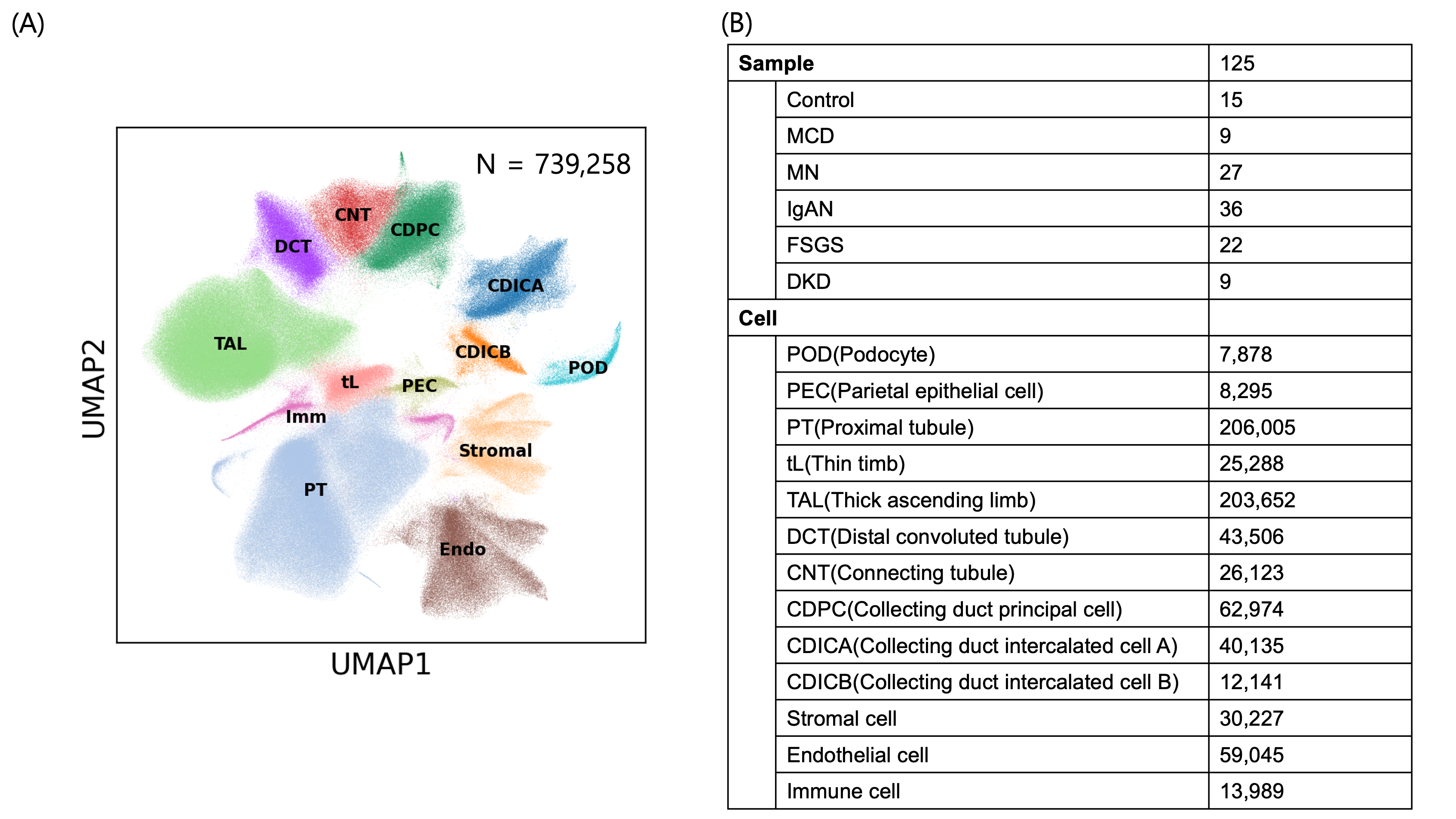
Results : The integrated dataset is unprecedented in scale, encompassing 125 samples and yielding 739,258 high-quality individual nuclei. The cohort extensively covers major nephropathies: 36 IgA nephropathy, 27 membranous nephropathy, 22 focal segmental glomerulosclerosis, 9 minimal change disease, 9 diabetic kidney disease, and 15 controls. High-resolution clustering successfully mapped a vast array of renal cell types. We captured major populations including 206,005 proximal tubule and 203,652 thick ascending limb cells, alongside 59,045 endothelial, 30,227 stromal, and 13,989 immune cells. The massive scale enabled the robust capture of critical rare cells, yielding 7,878 podocytes and 8,295 parietal epithelial cells. The dataset also meticulously profiled distal segments, identifying 62,974 collecting duct principal cells, 43,506 distal convoluted tubule cells, 52,276 intercalated cells, 26,123 connecting tubule cells, and 25,288 thin limb cells.
Conclusions : By establishing this massive snRNA-seq dataset, we provide a highly powered transcriptomic resource. This large-scale atlas overcomes previous sample size limitations, offering unprecedented opportunities to explore cell-specific mechanisms driving glomerular diseases.
Methods : We analyzed snRNA-seq data from human kidney biopsy cores. Strict quality control included rigorous mitochondrial gene cutoffs suitable for kidney tissues and doublet removal utilizing DoubletFinder. Data normalization was conducted with SCTransform, and batch effects across the extensive cohort were corrected using the Harmony integration algorithm.
Results : The integrated dataset is unprecedented in scale, encompassing 125 samples and yielding 739,258 high-quality individual nuclei. The cohort extensively covers major nephropathies: 36 IgA nephropathy, 27 membranous nephropathy, 22 focal segmental glomerulosclerosis, 9 minimal change disease, 9 diabetic kidney disease, and 15 controls. High-resolution clustering successfully mapped a vast array of renal cell types. We captured major populations including 206,005 proximal tubule and 203,652 thick ascending limb cells, alongside 59,045 endothelial, 30,227 stromal, and 13,989 immune cells. The massive scale enabled the robust capture of critical rare cells, yielding 7,878 podocytes and 8,295 parietal epithelial cells. The dataset also meticulously profiled distal segments, identifying 62,974 collecting duct principal cells, 43,506 distal convoluted tubule cells, 52,276 intercalated cells, 26,123 connecting tubule cells, and 25,288 thin limb cells.
Conclusions : By establishing this massive snRNA-seq dataset, we provide a highly powered transcriptomic resource. This large-scale atlas overcomes previous sample size limitations, offering unprecedented opportunities to explore cell-specific mechanisms driving glomerular diseases.
figure.png