Abstract Type : Oral presentation
Abstract Submission No.: A-0290
Abstract Topic : Basic Research
Dapagliflozin Attenuates PM2.5-Induced Renal Tubular Cell Injury via Modulation of EGR-1 and MAPK Signaling Pathways
Hyung Eun Yim1, Yoon Jeong Nam2, Yu-Seon Lee2, Ju-Han Lee3
1Department of Pediatrics-Nephrology, Korea University Ansan Hospital, Korea, Republic of
2Department of Medical Science Research Center, Korea University Ansan Hospital, Korea, Republic of
3Department of Pathology, Korea University Ansan Hospital, Korea, Republic of
Objectives : Dapagliflozin (DAPA), a sodium–glucose co-transporter 2 inhibitor, demonstrates renoprotective properties across various kidney diseases. Early growth response-1 (EGR-1), a transcription factor, exerts context-dependent roles in regulating inflammatory responses and tissue repair. This study examined fine particulate matter (PM₂.₅)-induced mitogen-activated protein kinase (MAPK) activation and inflammation in human renal proximal tubular cells, focusing on EGR-1 regulation and the potential protective effects of DAPA.
Methods : HK-2 cells were exposed to PM₂.₅ with or without DAPA (40 μM) for 48 h. Cytotoxicity was measured using a cell counting kit-8 assay. EGR-1 and extracellular signal-regulated kinase (ERK) activities were assessed over PM₂.₅ exposure time. Western blotting was performed for EGR-1, ERK, p38, c-Jun N-terminal kinase, intercellular adhesion molecule-1 (ICAM-1), and vascular cell adhesion molecule-1. MAPK activity was further examined following EGR-1 knockdown or overexpression, with or without PM₂.₅.
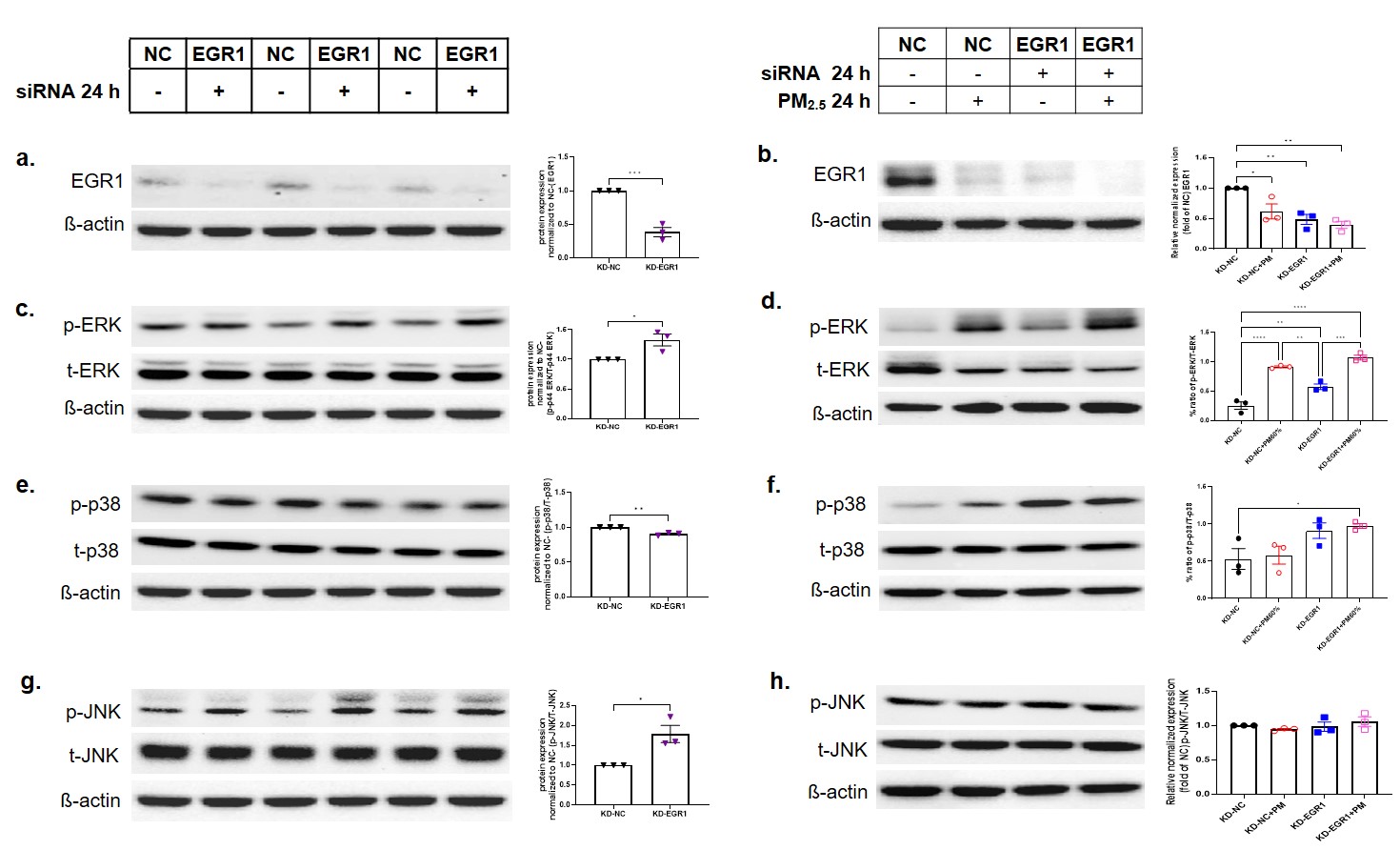
Results : PM₂.₅ reduced the viability of HK-2 cells in a dose- and time-dependent manner. EGR-1 exhibited an initial transient increase followed by a decline, whereas the phosphorylated ERK (p-ERK)/total ERK (t-ERK) ratio progressively increased. After 48 h, p-ERK/t-ERK, phosphorylated p38 (p-p38)/total p38 (t-p38), and ICAM-1 levels were elevated, while EGR-1 activity was reduced. EGR-1 silencing enhanced the p-ERK/t-ERK ratio, and PM₂.₅ further increased this ratio irrespective of EGR-1 status. DAPA improved cell viability, restored EGR-1 activity, and reduced p-ERK/t-ERK and p-p38/t-p38 ratios.
Conclusions : PM₂.₅ induces a rapid, transient EGR-1 activation, followed by sustained MAPK signaling and inflammatory adhesion molecule expression. DAPA alleviates PM₂.₅-induced cytotoxicity by suppressing ERK and p38 activation and restoring EGR-1, indicating its therapeutic potential against PM₂.₅-mediated renal tubular cell injury.
Methods : HK-2 cells were exposed to PM₂.₅ with or without DAPA (40 μM) for 48 h. Cytotoxicity was measured using a cell counting kit-8 assay. EGR-1 and extracellular signal-regulated kinase (ERK) activities were assessed over PM₂.₅ exposure time. Western blotting was performed for EGR-1, ERK, p38, c-Jun N-terminal kinase, intercellular adhesion molecule-1 (ICAM-1), and vascular cell adhesion molecule-1. MAPK activity was further examined following EGR-1 knockdown or overexpression, with or without PM₂.₅.
Results : PM₂.₅ reduced the viability of HK-2 cells in a dose- and time-dependent manner. EGR-1 exhibited an initial transient increase followed by a decline, whereas the phosphorylated ERK (p-ERK)/total ERK (t-ERK) ratio progressively increased. After 48 h, p-ERK/t-ERK, phosphorylated p38 (p-p38)/total p38 (t-p38), and ICAM-1 levels were elevated, while EGR-1 activity was reduced. EGR-1 silencing enhanced the p-ERK/t-ERK ratio, and PM₂.₅ further increased this ratio irrespective of EGR-1 status. DAPA improved cell viability, restored EGR-1 activity, and reduced p-ERK/t-ERK and p-p38/t-p38 ratios.
Conclusions : PM₂.₅ induces a rapid, transient EGR-1 activation, followed by sustained MAPK signaling and inflammatory adhesion molecule expression. DAPA alleviates PM₂.₅-induced cytotoxicity by suppressing ERK and p38 activation and restoring EGR-1, indicating its therapeutic potential against PM₂.₅-mediated renal tubular cell injury.
Fig 1.jpg
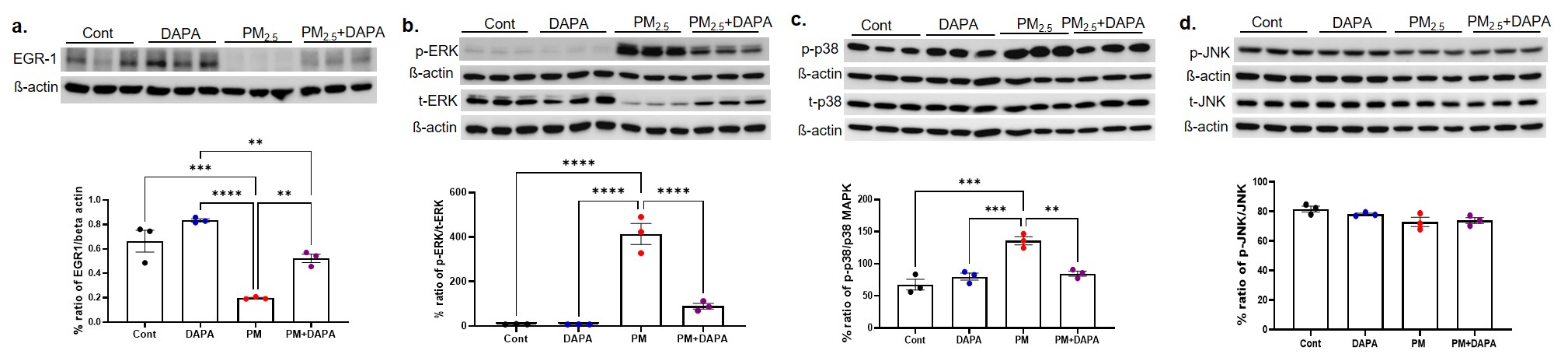
Fig 1.jpg