Abstract Type : Oral presentation
Abstract Submission No.: A-0284
Abstract Topic : Interventional Nephrology
Real-World Outcomes of COVERA Stent Graft for Venous Anastomosis Stenosis in Arteriovenous Grafts: A Single-Center Experience
Sangeon Gwoo1, Sunmin Kim1, Woon Heo2, Kinyun Kim2, Jongwon Kim2, Heekyung Jung3
1Department of Internal Medicine-Nephrology, Lifeline Clinic, Korea, Republic of
2Department of Thoracic and Cardiovascular Surgery, Lifeline Clinic, Korea, Republic of
3Department of Surgery, Lifeline Clinic, Korea, Republic of
Objectives : Venous anastomosis stenosis (VAS) is the primary cause of arteriovenous graft (AVG) dysfunction. The COVERA vascular covered stent (Bard Peripheral Vascular), a heparin-bonded ePTFE stent graft, has shown efficacy in extending target lesion primary patency in clinical trials; however, real-world data from Asian populations remain scarce. This study evaluated the intervention rate and patency outcomes of COVERA in AVG patients at a single Korean hemodialysis center.
Methods : We retrospectively analyzed 65 AVG patients who received COVERA stent grafts between April 2023 and February 2026 (one patient excluded for rescue placement due to pseudoaneurysm). Follow-up was obtained from procedural records and clinic visits. The primary endpoint was the intervention rate (events/patient-year). Secondary endpoints included primary patency (time to first re-intervention) and secondary patency (time to access abandonment) by Kaplan-Meier analysis. Death was treated as a censoring event.
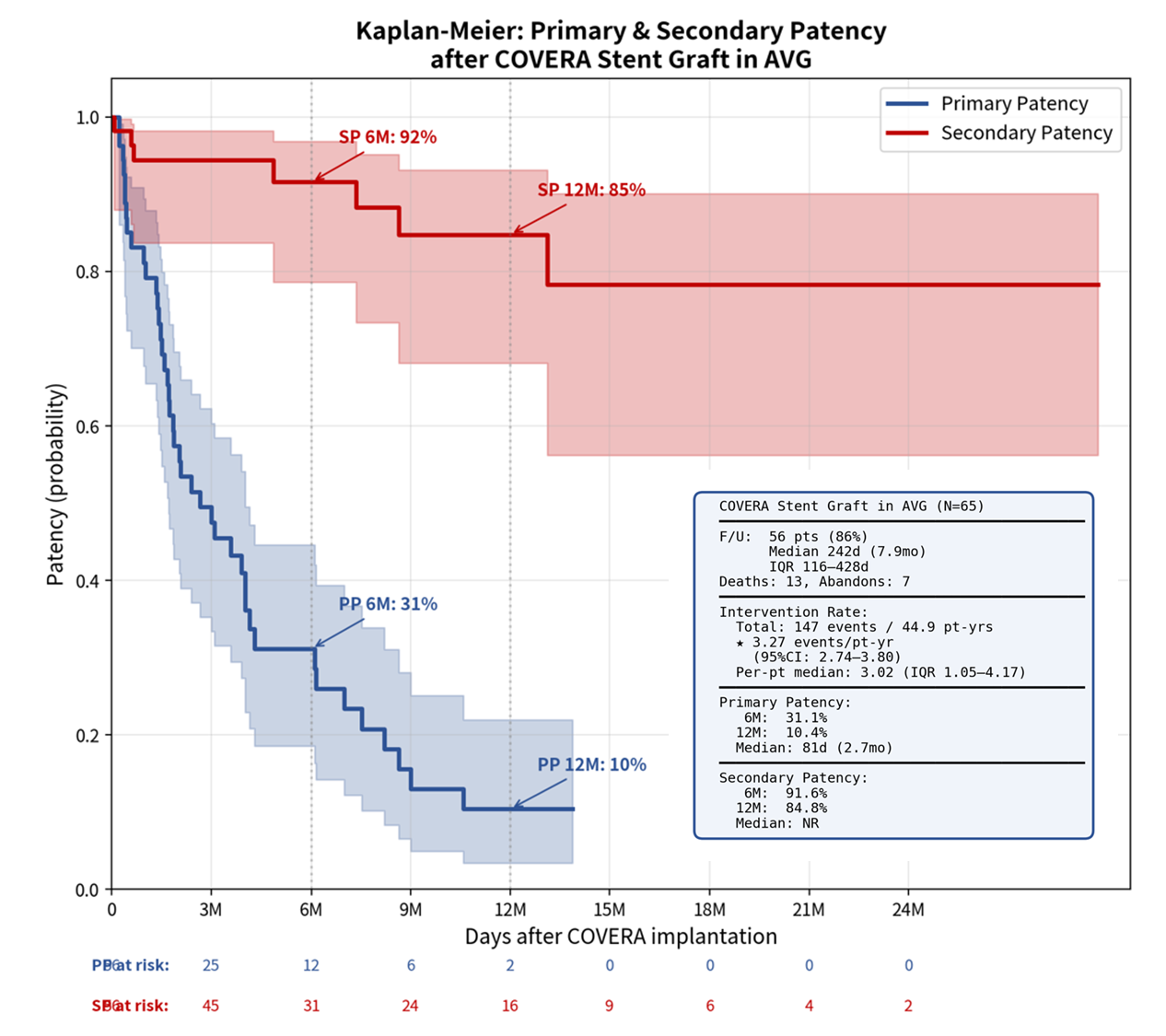
Results : Over a median follow-up of 242 days (IQR 116–428), 13 patients died and 7 underwent access abandonment. A total of 147 re-interventions over 44.9 patient-years yielded an intervention rate of 3.27 events/patient-year (95% CI: 2.74–3.80). Median primary patency was 81 days; 6- and 12-month primary patency rates were 31.1% and 10.4%, respectively. Secondary patency remained high at 91.6% at 6 months and 84.8% at 12 months, with the median not reached (Table 1, Figure 1).
Conclusions : COVERA stent grafts demonstrated low primary patency but excellent 12-month secondary patency (84.8%), confirming that repeated endovascular interventions effectively maintained graft function. The high re-intervention rate was partly attributable to thrombotic occlusion from intravascular volume depletion, an inherent vulnerability of AVGs, rather than stent graft failure alone. Early abandonment in several cases reflected COVERA use as a last resort before planned surgical revision. Although lesion-specific analysis was not performed in this study, our findings support COVERA as a viable option for maintaining AVG patency through an assisted patency strategy.
Methods : We retrospectively analyzed 65 AVG patients who received COVERA stent grafts between April 2023 and February 2026 (one patient excluded for rescue placement due to pseudoaneurysm). Follow-up was obtained from procedural records and clinic visits. The primary endpoint was the intervention rate (events/patient-year). Secondary endpoints included primary patency (time to first re-intervention) and secondary patency (time to access abandonment) by Kaplan-Meier analysis. Death was treated as a censoring event.
Results : Over a median follow-up of 242 days (IQR 116–428), 13 patients died and 7 underwent access abandonment. A total of 147 re-interventions over 44.9 patient-years yielded an intervention rate of 3.27 events/patient-year (95% CI: 2.74–3.80). Median primary patency was 81 days; 6- and 12-month primary patency rates were 31.1% and 10.4%, respectively. Secondary patency remained high at 91.6% at 6 months and 84.8% at 12 months, with the median not reached (Table 1, Figure 1).
Conclusions : COVERA stent grafts demonstrated low primary patency but excellent 12-month secondary patency (84.8%), confirming that repeated endovascular interventions effectively maintained graft function. The high re-intervention rate was partly attributable to thrombotic occlusion from intravascular volume depletion, an inherent vulnerability of AVGs, rather than stent graft failure alone. Early abandonment in several cases reflected COVERA use as a last resort before planned surgical revision. Although lesion-specific analysis was not performed in this study, our findings support COVERA as a viable option for maintaining AVG patency through an assisted patency strategy.
table.png
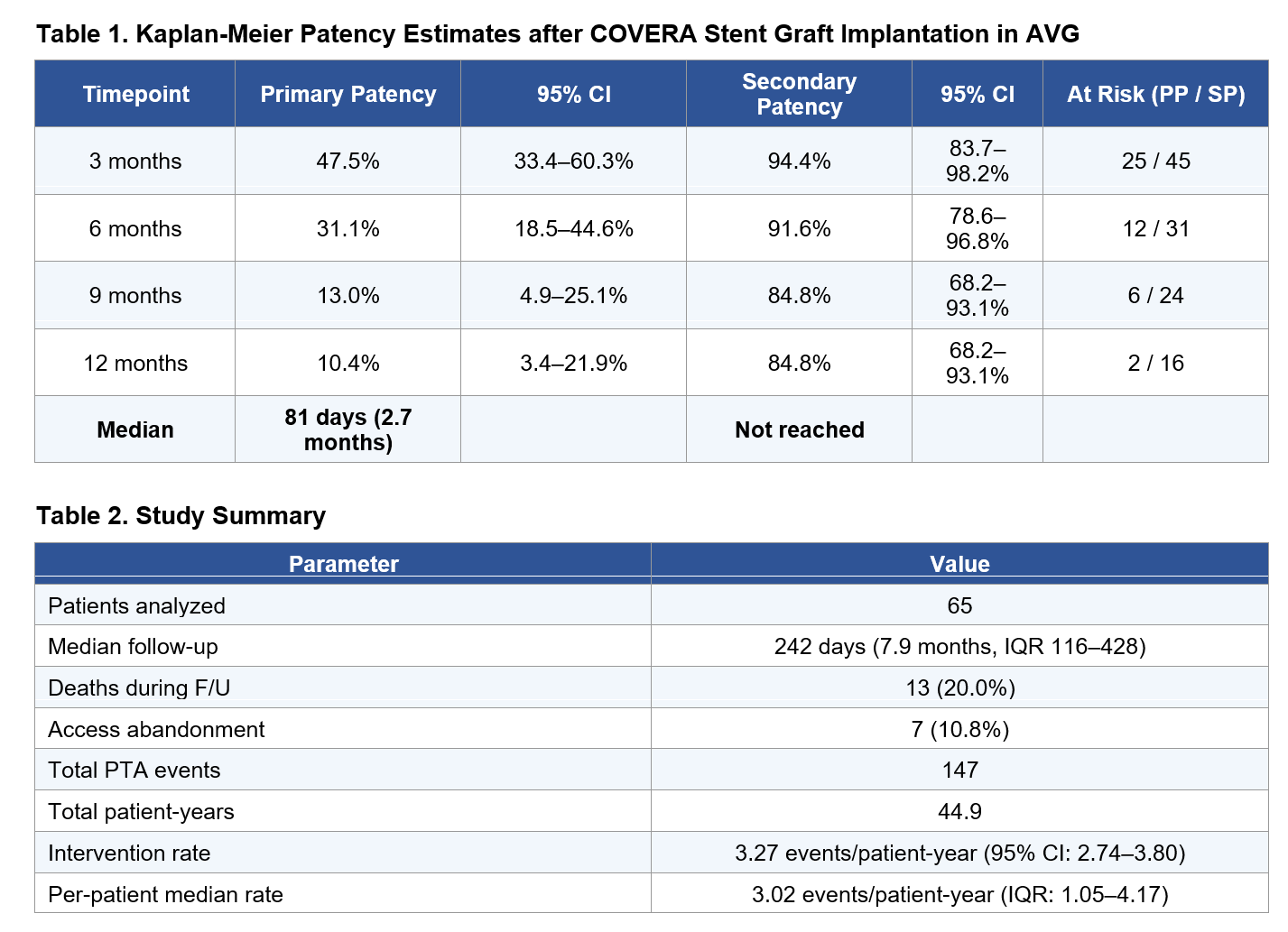
table.png