Abstract Type : Oral presentation
Abstract Submission No.: A-0252
Abstract Topic : Dialysis
Clonal Hematopoiesis of Indeterminate Potential and Cardiovascular Outcomes in Patients Undergoing Maintenance Hemodialysis
Baek Jihyun1, Hye Yun Jeong1, Kipyo Kim1, So-Young Lee1, Yu Ho Lee2
1Department of Internal Medicine-Nephrology, CHA Bundang Medical Center, Korea, Republic of
2Department of Internal Medicine-Nephrology, Kyung Hee University Medical Center, Korea, Republic of
Objectives : Clonal hematopoiesis of indeterminate potential (CHIP) is an age-related expansion of hematopoietic stem cell clones carrying somatic mutations that can alter immune function and promote chronic inflammation. Recent studies have shown that CHIP is associated with an increased risk of cardiovascular disease and helps predict cardiovascular risk to an extent similar to that of traditional risk factors. However, the clinical significance of CHIP has rarely been investigated in patients with end-stage kidney disease undergoing hemodialysis.
Methods : We prospectively enrolled 383 patients undergoing maintenance hemodialysis. CHIP was assessed using targeted sequencing with a customized gene panel. Echocardiographic parameters and plasma biomarker levels were measured at baseline. The primary outcomes were cardiovascular events and all-cause mortality.
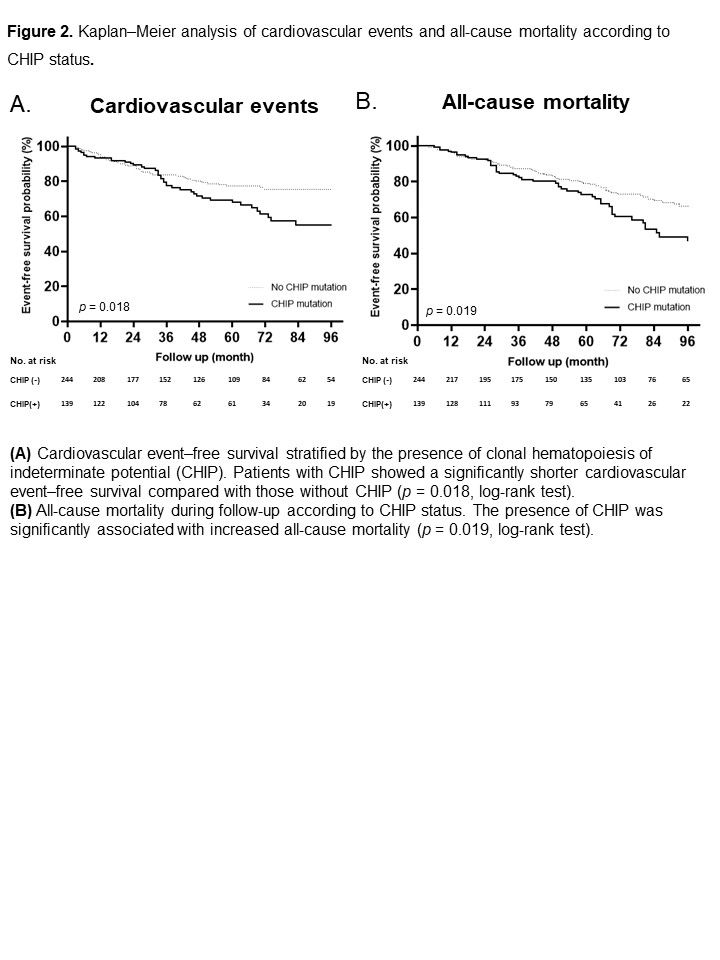
Results : CHIP was detected in 36.3% of the enrolled patients (139/383), with DNMT3A being the most frequently mutated gene, accounting for 29.6% of all identified variants (55/186). Plasma levels of CCL13 and PCSK9 were elevated in CHIP carriers, whereas echocardiographic parameters did not show any association. Patients with CHIP exhibited higher cumulative rates of cardiovascular events and all-cause mortality compared with those without CHIP (P = 0.018 and 0.019, respectively). In multivariable Cox regression analysis, CHIP was independently associated with an increased cardiovascular risk (adjusted hazard ratio 1.53, 95% confidence interval 1.00–2.35). Sensitivity analyses revealed that DNMT3A-CHIP was associated with an increased risk of cardiovascular events, whereas non-DNMT3A-CHIP was not.
Conclusions : In patients with end-stage kidney disease undergoing maintenance hemodialysis, CHIP was associated with an increased risk of adverse cardiovascular outcomes, primarily driven by DNMT3A-CHIP.
Methods : We prospectively enrolled 383 patients undergoing maintenance hemodialysis. CHIP was assessed using targeted sequencing with a customized gene panel. Echocardiographic parameters and plasma biomarker levels were measured at baseline. The primary outcomes were cardiovascular events and all-cause mortality.
Results : CHIP was detected in 36.3% of the enrolled patients (139/383), with DNMT3A being the most frequently mutated gene, accounting for 29.6% of all identified variants (55/186). Plasma levels of CCL13 and PCSK9 were elevated in CHIP carriers, whereas echocardiographic parameters did not show any association. Patients with CHIP exhibited higher cumulative rates of cardiovascular events and all-cause mortality compared with those without CHIP (P = 0.018 and 0.019, respectively). In multivariable Cox regression analysis, CHIP was independently associated with an increased cardiovascular risk (adjusted hazard ratio 1.53, 95% confidence interval 1.00–2.35). Sensitivity analyses revealed that DNMT3A-CHIP was associated with an increased risk of cardiovascular events, whereas non-DNMT3A-CHIP was not.
Conclusions : In patients with end-stage kidney disease undergoing maintenance hemodialysis, CHIP was associated with an increased risk of adverse cardiovascular outcomes, primarily driven by DNMT3A-CHIP.
Figure 1.jpg
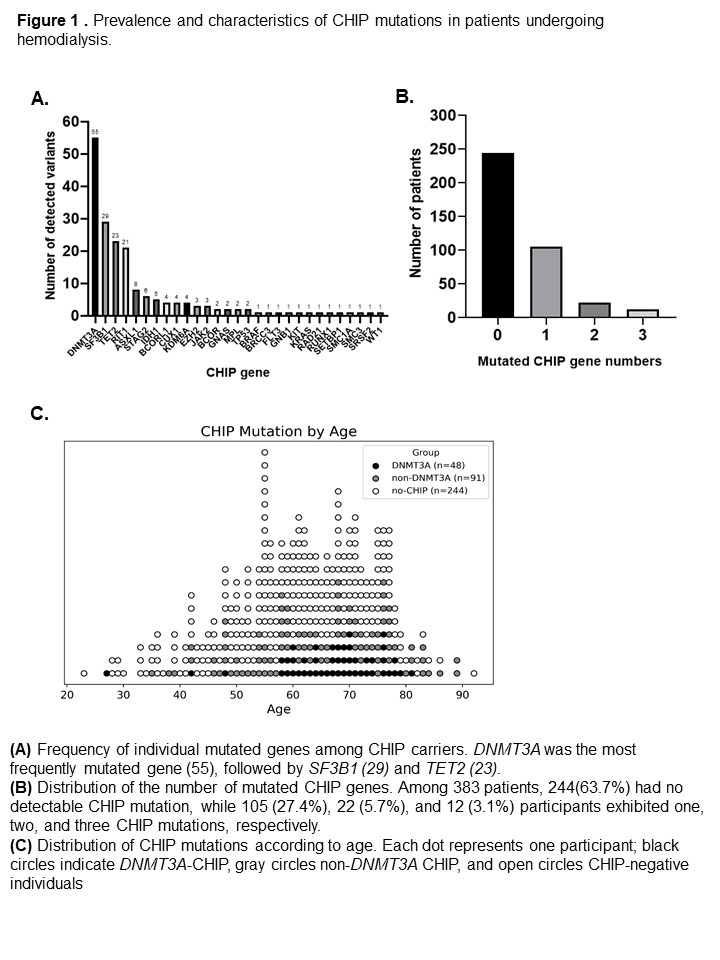
Figure 1.jpg