Abstract Type : Oral presentation
Abstract Submission No.: A-0190
Abstract Topic : Acute Kidney Injury
Evaluation of Longitudinal Plasma and Urinary Biomarkers for Predicting Acute Kidney Disease in Patients with Sepsis-Associated Acute Kidney Injury: A Prospective Cohort Study
Ha-Eun Lee1, Seung Hee Jeong1, In O Sun1, Ju Hwan Oh1, A Young Cho1, Kwang-Hee Shin3, Kyung Pyo Kang2
1Department of Internal Medicine-Nephrology, Presbyterian Medical Center, Korea, Republic of
2Department of Pharmacology, Kyungpook National University Hospital, Korea, Republic of
3Department of Internal Medicine-Nephrology, Chonbuk National University Hospital, Korea, Republic of
Objectives : Sepsis is the leading cause of acute kidney injury (AKI). Beyond early mortality, survivors risk persistent kidney function decline, leading to acute kidney disease (AKD). Although AKD represents a critical transition period toward chronic kidney disease (CKD), biomarkers predicting AKD progression in patients with sepsis-associated AKI (SA-AKI) are limited. Therefore, we evaluated longitudinal plasma and urinary biomarkers for predicting AKD following SA-AKI.
Methods : This prospective, single-center, cohort study screened adults with SA-AKI (Jan 2024–Nov 2025). SA-AKI was defined by Sepsis-3 and Kidney Disease: Improving Global Outcomes criteria as the concurrent presence of sepsis and AKI. After excluding patients with end-stage kidney disease, prior kidney transplantation, or baseline estimated glomerular filtration rate < 45 mL/min/1.73m2, 56 patients were eligible. Of these, 50 who completed a 7-day follow-up were included in the final analysis (Figure 1A). Plasma and urine samples were collected at 0, 6, and 48 hours after diagnosis (Figure 1B). The primary outcome was AKD development at Day 7, defined by the 16th Acute Disease Quality Initiative consensus.
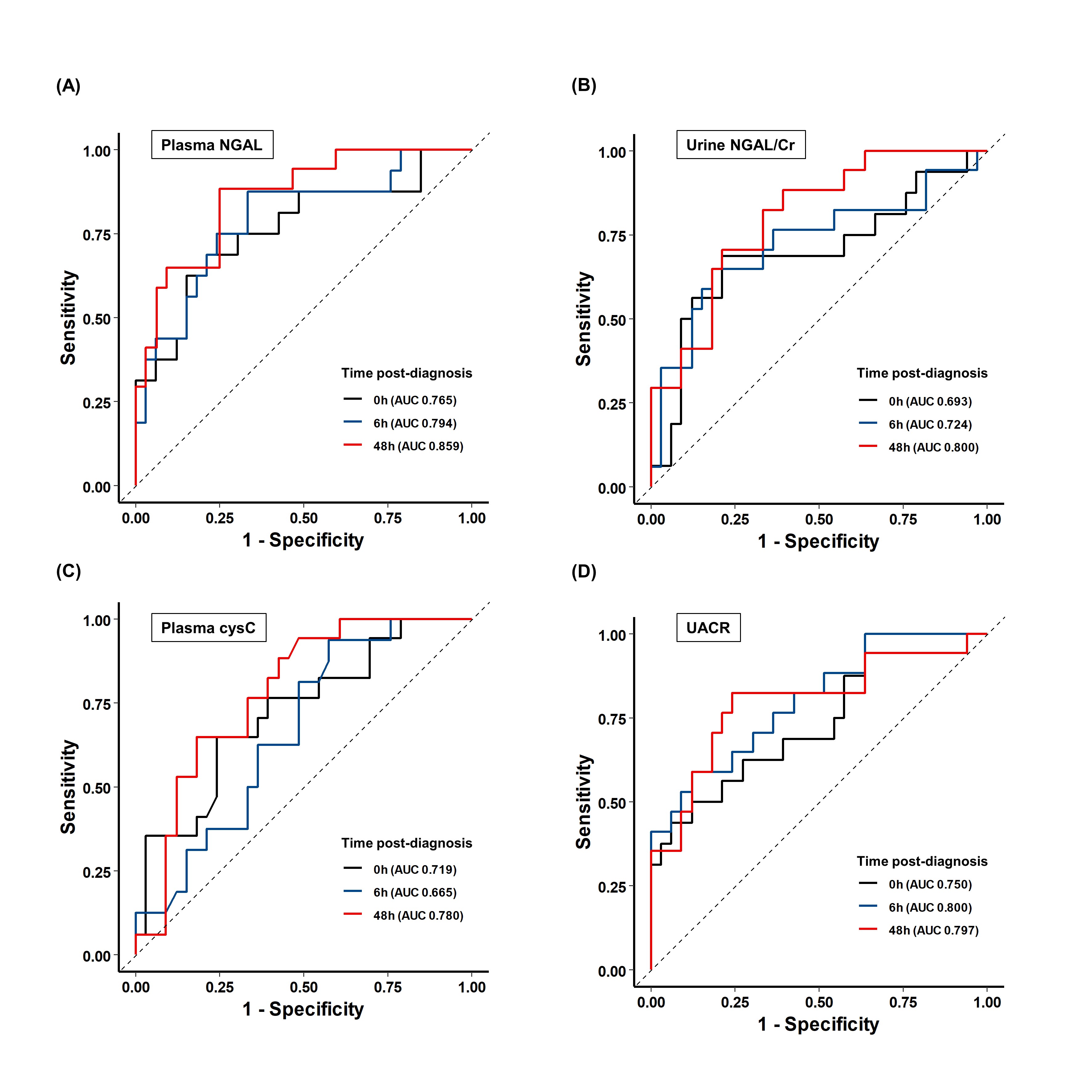
Results : The cohort had a median age of 77 years (52.0% male) and 17 (34.0%) had pre-existing CKD. AKD developed in 17 (34.0%) patients, while the remaining 33 (66.0%) recovered without AKD. Patients with AKD more frequently presented with stage 3 AKI (88.2% vs. 33.3%, P = 0.001) and required kidney replacement therapy (47.1% vs. 9.1%, P = 0.007) than those without AKD. Among longitudinal biomarkers of tubular injury, glomerular filtration, and glomerular injury, the discriminatory performance generally improved over 48 hours (Figure 2). Plasma neutrophil gelatinase-associated lipocalin (NGAL) measured at 48 hours demonstrated the highest area under the receiver operating characteristic curve (0.859; 95% confidence interval, 0.752–0.965, P < 0.001).
Conclusions : Among evaluated biomarkers, plasma NGAL measured at 48 hours post-diagnosis demonstrated the highest discriminatory performance for AKD progression following SA-AKI.
Methods : This prospective, single-center, cohort study screened adults with SA-AKI (Jan 2024–Nov 2025). SA-AKI was defined by Sepsis-3 and Kidney Disease: Improving Global Outcomes criteria as the concurrent presence of sepsis and AKI. After excluding patients with end-stage kidney disease, prior kidney transplantation, or baseline estimated glomerular filtration rate < 45 mL/min/1.73m2, 56 patients were eligible. Of these, 50 who completed a 7-day follow-up were included in the final analysis (Figure 1A). Plasma and urine samples were collected at 0, 6, and 48 hours after diagnosis (Figure 1B). The primary outcome was AKD development at Day 7, defined by the 16th Acute Disease Quality Initiative consensus.
Results : The cohort had a median age of 77 years (52.0% male) and 17 (34.0%) had pre-existing CKD. AKD developed in 17 (34.0%) patients, while the remaining 33 (66.0%) recovered without AKD. Patients with AKD more frequently presented with stage 3 AKI (88.2% vs. 33.3%, P = 0.001) and required kidney replacement therapy (47.1% vs. 9.1%, P = 0.007) than those without AKD. Among longitudinal biomarkers of tubular injury, glomerular filtration, and glomerular injury, the discriminatory performance generally improved over 48 hours (Figure 2). Plasma neutrophil gelatinase-associated lipocalin (NGAL) measured at 48 hours demonstrated the highest area under the receiver operating characteristic curve (0.859; 95% confidence interval, 0.752–0.965, P < 0.001).
Conclusions : Among evaluated biomarkers, plasma NGAL measured at 48 hours post-diagnosis demonstrated the highest discriminatory performance for AKD progression following SA-AKI.
Figure 1_260225.jpg
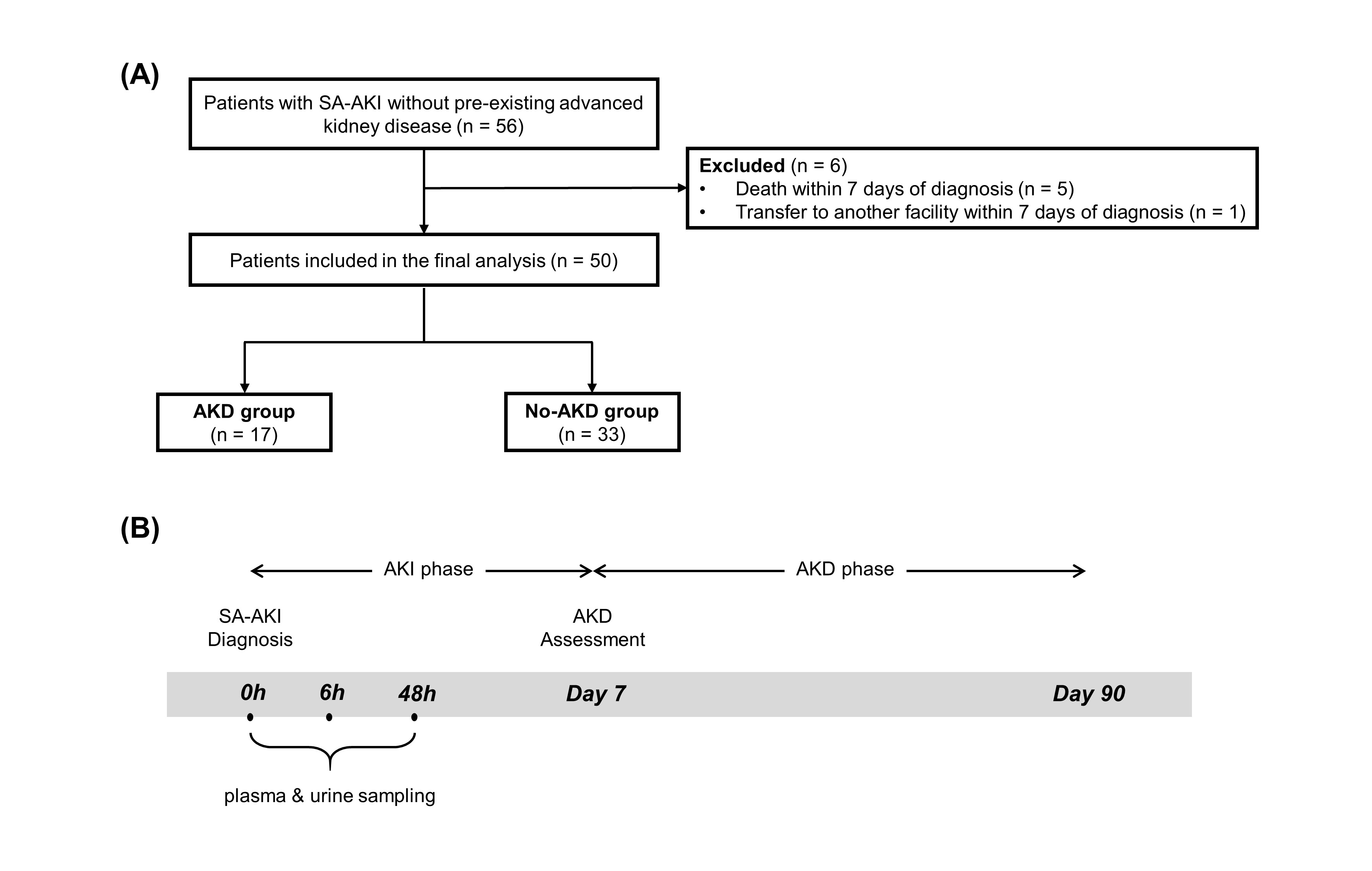
Figure 1_260225.jpg