Abstract Type : Oral presentation
Abstract Submission No.: A-0124
Abstract Topic : Non-dialysis CKD
The K-SALT Equation: Development and Validation of a Population-Specific Formula for Estimating 24-Hour Urinary Sodium Excretion in Korean Patients with Chronic Kidney Disease
Semin Cho1, Hayne Cho Park3, Woo Yeong Park4, Seo Rin Kim5, Ji-Young Choi7, Haekyung Lee8, Jangwook Lee9, Hyeong Cheon Park6, Ji Yong Jung2
1Department of Internal Medicine-Nephrology, Chung-Ang University Gwangmyeong Hospital, Korea, Republic of
2Department of Internal Medicine-Nephrology, Gachon University Gil Medical Center, Korea, Republic of
3Department of Internal Medicine-Nephrology, Kangnam Sacred Heart Hospital, Korea, Republic of
4Department of Internal Medicine-Nephrology, Keimyung University Dongsan Medical Center, Korea, Republic of
5Department of Internal Medicine-Nephrology, Pusan National University Yangsan Hospital, Korea, Republic of
6Department of Internal Medicine-Nephrology, Gangnam Severance Hospital, Korea, Republic of
7Department of Internal Medicine-Nephrology, Kyungpook National University Medical Center, Korea, Republic of
8Department of Internal Medicine-Nephrology, Soonchunhyang University Seoul Hospital, Korea, Republic of
9Department of Internal Medicine-Nephrology, Dongguk University Ilsan Hospital, Korea, Republic of
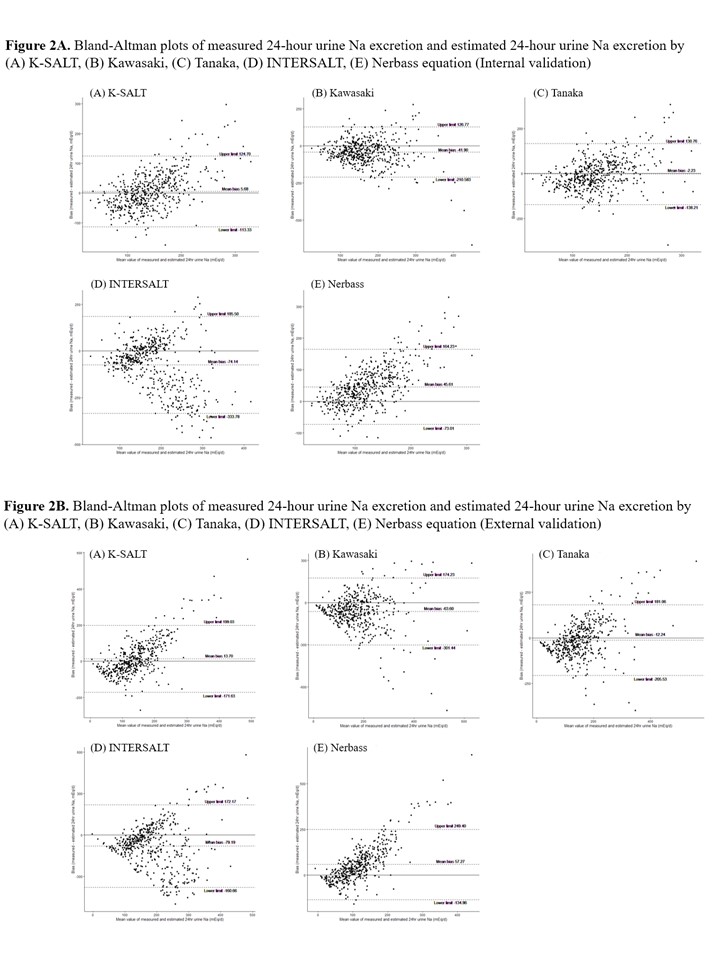
Methods : This study employed a hybrid cohort design across 16 teaching hospitals in Korea. Data for the development and internal validation cohorts were prospectively collected according to a standardized urine collection protocol, whereas data for the external validation cohort were retrospectively obtained from an independent patient group. Multiple regression models were constructed using demographic, anthropometric, and spot urine variables, and their performance was compared with existing equations using intraclass correlation coefficients (ICC), mean bias, and area under the curve (AUC) analyses.
Results : A total of 1,637 patients with CKD were included in this study (1,077 for the development and internal validation, and 560 for the external validation). The K-SALT equation demonstrated superior performance compared with previously reported formulas, showing higher ICC and AUC values with smaller mean prediction error. External validation confirmed its robustness across CKD stages and subgroups.
Conclusions : The K-SALT study provides the first large-scale, population-specific equation for estimating 24hUNa excretion in Korean patients with CKD. By better reflecting the demographic and clinical characteristics of this population, the K-SALT equation enables more accurate assessment of sodium intake and supports individualized dietary sodium management in CKD care.
Table 1.JPG

Table 1.JPG