Abstract Type : Oral presentation
Abstract Submission No.: A-0123
Abstract Topic : Non-dialysis CKD
Distinct Hemoglobin Trajectories and Their Prognostic Implications in Chronic Kidney Disease: Findings from the KNOW-CKD Cohort
Semin Cho1, Wookyung Chung2, Young Youl Hyun3, Jung Soon Kim4, Yeong Hoon Kim5, Sue Kyung Park6, Kook-Hwan Oh7, Ji Yong Jung2
1Department of Internal Medicine-Nephrology, Chung-Ang University Gwangmyeong Hospital, Korea, Republic of
2Department of Internal Medicine-Nephrology, Gachon University Gil Medical Center, Korea, Republic of
3Department of Internal Medicine-Nephrology, Kangbuk Samsung Medical Center, Korea, Republic of
4Department of Internal Medicine-Nephrology, Eulji University Hospital, Korea, Republic of
5Department of Internal Medicine-Nephrology, Inje University Busan Paik Hospital, Korea, Republic of
6Department of Preventive Medicine, Seoul National University College of Medicine, Korea, Republic of
7Department of Internal Medicine-Nephrology, Seoul National University Hospital, Korea, Republic of
Methods : We analyzed 1,940 adults with CKD from a prospective cohort, applying group-based trajectory modeling (GBTM) to repeated Hb measurements. The primary endpoint was a composite kidney outcome (≥50% decline in eGFR, doubling of serum creatinine, initiation of dialysis, or kidney transplantation). Secondary endpoints were cardiovascular events and all-cause mortality.
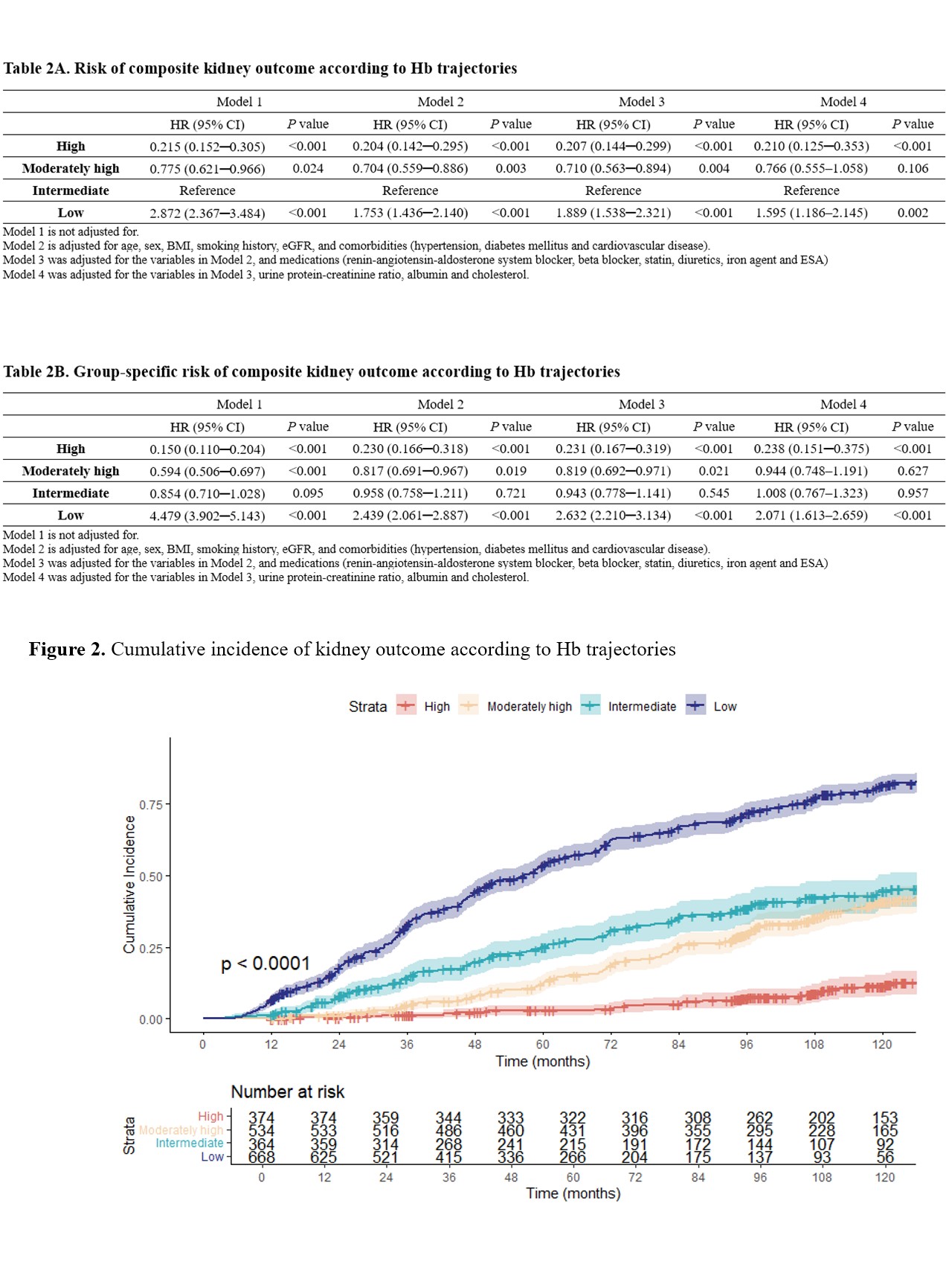
Results : GBTM identified four distinct Hb trajectories: high, moderately high, intermediate, and low. Compared with the intermediate trajectory, the high group showed substantially lower risk of the composite kidney outcome (hazard ratio [HR] 0.210, 95% confidence interval [CI] 0.125–0.353), the moderately high group showed comparable risk (HR 0.766, 95% CI 0.555–1.058), and the low group had higher risk (HR 1.595, 95% CI 1.186–2.145). No significant associations were observed with cardiovascular events or all-cause mortality after full adjustment.
Conclusions : Distinct Hb trajectories were strongly associated with kidney outcomes in CKD. Sustained higher Hb trajectories conferred favorable renal prognosis, whereas persistently low trajectories predicted adverse outcomes. Beyond static Hb values, trajectory-based assessment may provide a novel framework for individualized risk stratification and anemia management in CKD.
Figure 1.jpg
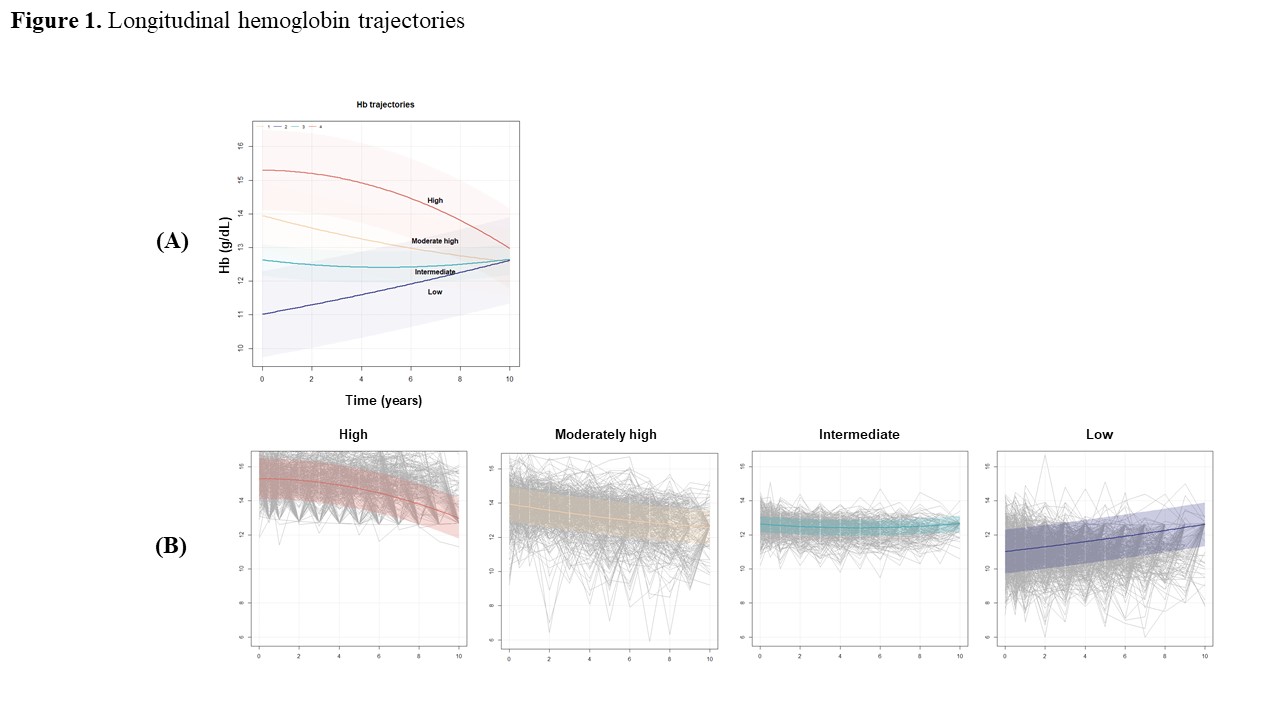
Figure 1.jpg