Abstract Type : Oral presentation
Abstract Submission No.: A-0043
Abstract Topic : Non-dialysis CKD
Development and Validation of East Asian Equation to Predict 24hr Urine Creatinine Excretion: Analysis of the KNOW-CKD Study
Eun Mi You, Jong Cheol Jeong
Department of Internal Medicine-Nephrology, Seoul National University Bundang Hospital, Korea, Republic of
Objectives : Urine creatinine excretion rate (CER) is an important marker for assessing the accuracy of 24-hour urine collection. Although several equations for estimating CER in Asian populations exist, they have not been sufficiently validated in East Asian populations. This study aimed to develop and validate new equations using the KNOW-CKD cohort.
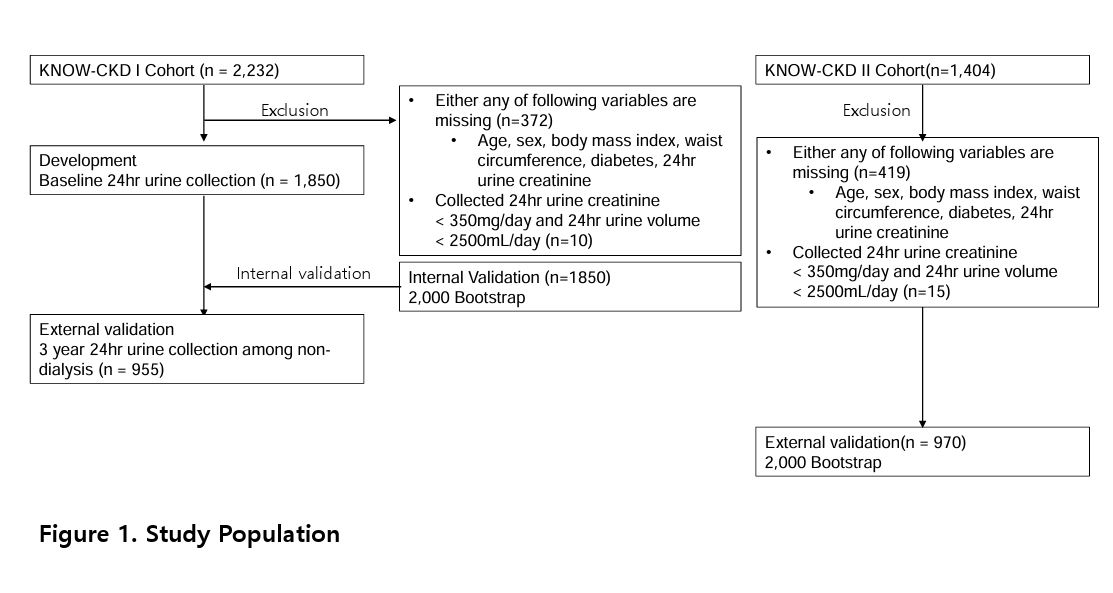
Methods : The derivation cohort consisted of 1,850 patients from the KNOW-CKD I, with external validation performed using 955 patients from the 3-year follow-up of KNOW-CKD I and 970 patients from the KNOW-CKD II. CER was modeled as the dependent variable in multivariable regression analysis with predictors including age, sex, weight, waist circumference, diabetes, estimated glomerular filtration rate based on cystatin C (eGFRcys), eGFR based on creatinine (eGFRcr), and the creatinine/cystatin C ratio (Cr/Cys). Eleven equations, including the CKD-EPI-Asian equation, were developed. The CKD-EPI-Asian equation was modified by incorporating Asian ethnicity as a binary variable (Asian = 1, non-Asian = 0) within the CKD-EPI framework, with only the intercept changed, to better account for ethnic differences in muscle mass and creatinine generation.
Results : The best formula for predicting CER is Equation 10:[ –1.702×age – 278.275×female + 14.382×weight + 1.854×eGFRcys – 93.038×diabetic CKD – 3.624×waist + 222.757×Cr/CysC ratio + 436.009] which exhibited a mean difference -17 mg/day [95% C.I. –34.4 to 5.2], IQR 334.2 mg/day [95% C.I. 309.5 to 366.7], and P30 75.7% [95% C.I. 72.9%–78.2%]). The CKD-EPI-Asian equation[–6.19×age + 12.51×weight – 379.42×female + 826.58] showed narrower median differences and lower RMSE compared to the original CKD-EPI equation. Both the CKD-EPI-Asian equation and new equations outperformed previously developed equations in accuracy.
Conclusions : The newly developed equations, along with the CKD-EPI-Asian equation, demonstrated good performance in predicting CER. Given its simplicity, the CKD-EPI-Asian equation can be widely applied for CER prediction, offering a reliable and practical tool for clinical use.
Methods : The derivation cohort consisted of 1,850 patients from the KNOW-CKD I, with external validation performed using 955 patients from the 3-year follow-up of KNOW-CKD I and 970 patients from the KNOW-CKD II. CER was modeled as the dependent variable in multivariable regression analysis with predictors including age, sex, weight, waist circumference, diabetes, estimated glomerular filtration rate based on cystatin C (eGFRcys), eGFR based on creatinine (eGFRcr), and the creatinine/cystatin C ratio (Cr/Cys). Eleven equations, including the CKD-EPI-Asian equation, were developed. The CKD-EPI-Asian equation was modified by incorporating Asian ethnicity as a binary variable (Asian = 1, non-Asian = 0) within the CKD-EPI framework, with only the intercept changed, to better account for ethnic differences in muscle mass and creatinine generation.
Results : The best formula for predicting CER is Equation 10:[ –1.702×age – 278.275×female + 14.382×weight + 1.854×eGFRcys – 93.038×diabetic CKD – 3.624×waist + 222.757×Cr/CysC ratio + 436.009] which exhibited a mean difference -17 mg/day [95% C.I. –34.4 to 5.2], IQR 334.2 mg/day [95% C.I. 309.5 to 366.7], and P30 75.7% [95% C.I. 72.9%–78.2%]). The CKD-EPI-Asian equation[–6.19×age + 12.51×weight – 379.42×female + 826.58] showed narrower median differences and lower RMSE compared to the original CKD-EPI equation. Both the CKD-EPI-Asian equation and new equations outperformed previously developed equations in accuracy.
Conclusions : The newly developed equations, along with the CKD-EPI-Asian equation, demonstrated good performance in predicting CER. Given its simplicity, the CKD-EPI-Asian equation can be widely applied for CER prediction, offering a reliable and practical tool for clinical use.
Figure1.study population.JPG