Abstract Type : Oral presentation
Abstract Submission No.: A-0015
Abstract Topic : Fluid, Electrolyte and Acid-base Disorder
Comparative Efficacy and Safety of Therapies for Syndrome of Inappropriate Antidiuresis-Associated Hyponatremia: A Systematic Review and Network Meta-Analysis
Joseph Paulo Gonzales1, Jastine Wenn Galvez1, Kevin Elissandro Gumabon
1Department of Internal Medicine, University of the Philippines Manila - Philippine General Hospital, Philippines
2Department of Internal Medicine-Nephrology, University of the Philippines Manila - Philippine General Hospital, Philippines
Objectives : Several pharmacologic and non-pharmacologic therapies have been used to treat syndrome of inappropriate antidiuresis (SIAD)–associated hyponatremia, yet their relative efficacy and safety remain uncertain. This network meta-analysis evaluated and ranked available treatments for SIAD to guide evidence-based management.
Methods : A systematic search of MEDLINE, CENTRAL, Scopus, and ClinicalTrials.gov was conducted from inception to December 2025. Randomized controlled trials comparing available therapies for SIAD in adults were included. Primary outcomes were change in serum sodium concentration and normalization of serum sodium. Safety outcomes included sodium overcorrection, neurologic complications, acute kidney injury, and mortality. Risk of bias was assessed using the Cochrane RoB 2 tool. A Bayesian random-effects NMA was performed using MetaInsight v6.4.0, and treatments were ranked using surface under the cumulative ranking (SUCRA) probabilities.
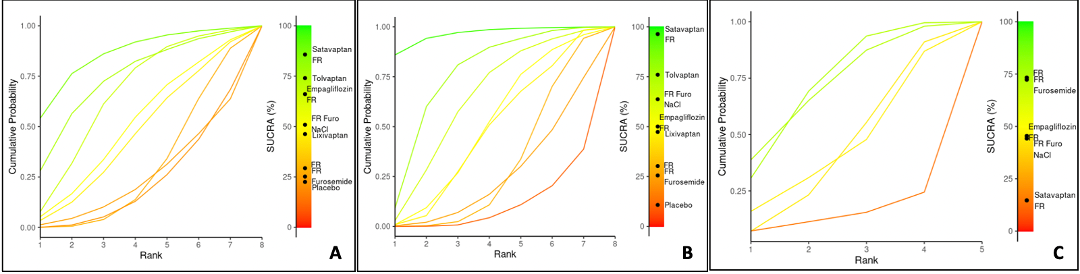
Results : Nine RCTs (711 participants) met the inclusion criteria, encompassing eight interventions. All active therapies, except furosemide with fluid restriction (FR), resulted in numerically greater increases in serum sodium compared with FR alone, although 95% credible intervals crossed zero. Satavaptan (SUCRA 85.8%), tolvaptan (74.0%), and empagliflozin (66.1%) ranked highest for increasing serum sodium, while FR (29.3%) and placebo (22.5%) ranked lowest. For sodium normalization, satavaptan (96.4%) and tolvaptan (76.0%) showed the highest probabilities of achieving normonatremia. Sodium overcorrection was uncommon but most frequent with satavaptan. FR and FR plus furosemide were the safest regimens. No treatment-related neurologic deficits or deaths were reported. Heterogeneity was moderate, and no global incoherence was detected. Overall certainty of evidence was moderate to high for dichotomous outcomes and moderate for change in serum sodium.
Conclusions : Among available SIAD therapies, vasopressin receptor antagonists and empagliflozin appear most effective for correcting hyponatremia, whereas FR-based regimens remain the safest with respect to sodium overcorrection. However, wide credible intervals and small sample sizes limit definitive conclusions.
Methods : A systematic search of MEDLINE, CENTRAL, Scopus, and ClinicalTrials.gov was conducted from inception to December 2025. Randomized controlled trials comparing available therapies for SIAD in adults were included. Primary outcomes were change in serum sodium concentration and normalization of serum sodium. Safety outcomes included sodium overcorrection, neurologic complications, acute kidney injury, and mortality. Risk of bias was assessed using the Cochrane RoB 2 tool. A Bayesian random-effects NMA was performed using MetaInsight v6.4.0, and treatments were ranked using surface under the cumulative ranking (SUCRA) probabilities.
Results : Nine RCTs (711 participants) met the inclusion criteria, encompassing eight interventions. All active therapies, except furosemide with fluid restriction (FR), resulted in numerically greater increases in serum sodium compared with FR alone, although 95% credible intervals crossed zero. Satavaptan (SUCRA 85.8%), tolvaptan (74.0%), and empagliflozin (66.1%) ranked highest for increasing serum sodium, while FR (29.3%) and placebo (22.5%) ranked lowest. For sodium normalization, satavaptan (96.4%) and tolvaptan (76.0%) showed the highest probabilities of achieving normonatremia. Sodium overcorrection was uncommon but most frequent with satavaptan. FR and FR plus furosemide were the safest regimens. No treatment-related neurologic deficits or deaths were reported. Heterogeneity was moderate, and no global incoherence was detected. Overall certainty of evidence was moderate to high for dichotomous outcomes and moderate for change in serum sodium.
Conclusions : Among available SIAD therapies, vasopressin receptor antagonists and empagliflozin appear most effective for correcting hyponatremia, whereas FR-based regimens remain the safest with respect to sodium overcorrection. However, wide credible intervals and small sample sizes limit definitive conclusions.
Network plots.png
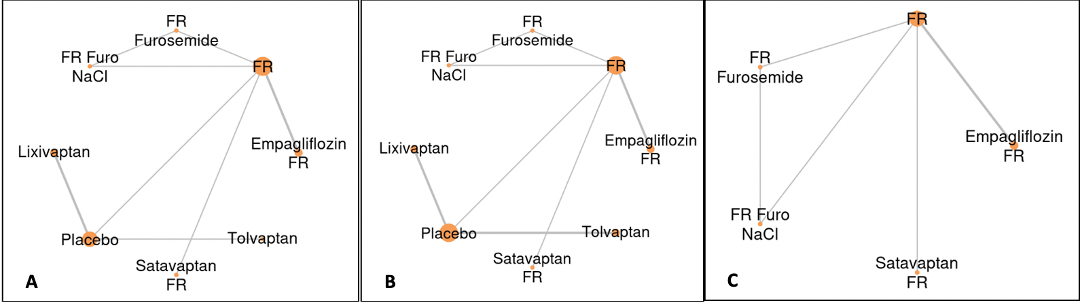
Network plots.png